
NHS Sterile Services Technician Pay 2026/27: Band 2-4
Last updated: 2 November 2026 · Figures verified against the NHS Employers 2026/27 pay circular.
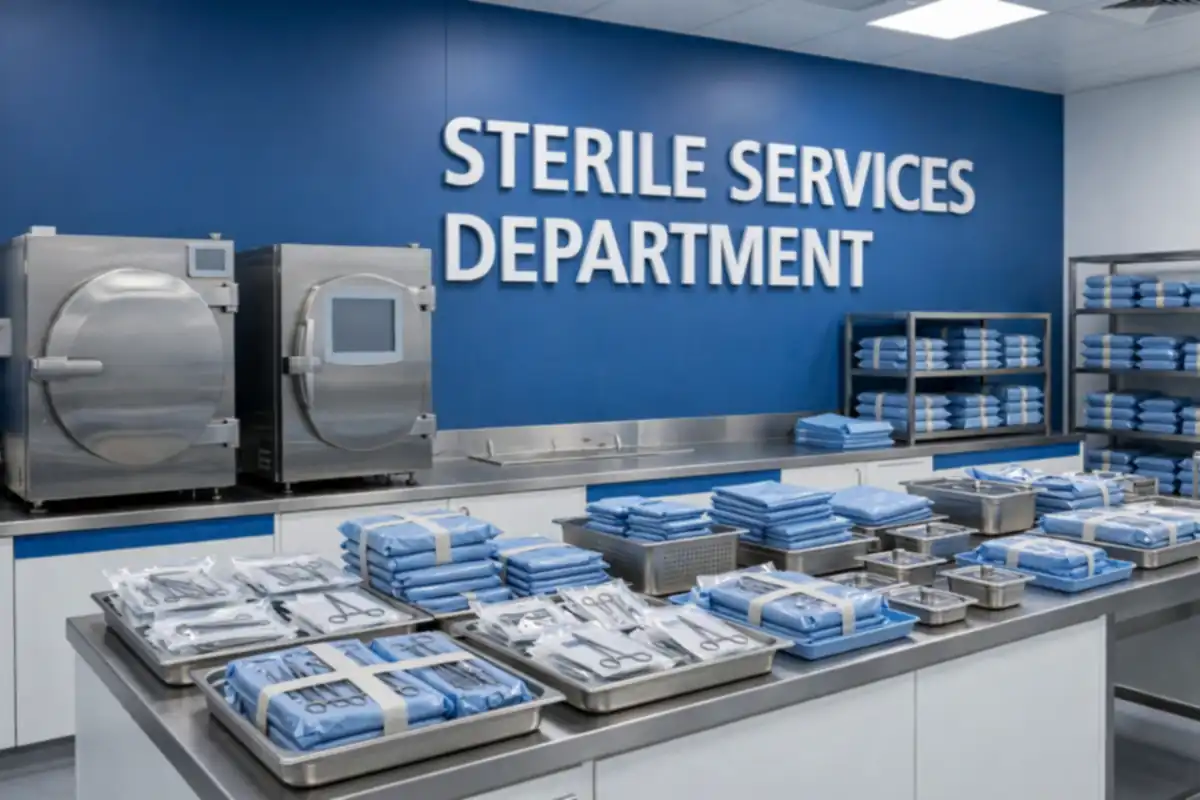
Sterile services technician pay 2026/27: the Band 2, Band 3 and Band 4 scales
England awarded Agenda for Change staff 3.3% from 1 April 2026, and that award is already in these figures. A sterile services technician in England in 2026/27 earns £25,272 at Band 2, £25,760 to £27,476 at Band 3 and £28,392 to £31,157 at Band 4, for a full-time 37.5-hour week. Band 2 is a single spot rate, with no steps: every Band 2 technician on a full-time contract earns the same basic pay. Band 3 has two steps, entry and top, and Band 4 has two steps, entry and top. The gap between the top of Band 3 (£27,476) and the entry of Band 4 (£28,392) is £916 a year, and the gap between Band 2 (£25,272) and Band 3 entry (£25,760) is only £488 a year. Those small gaps are normal at the bottom of Agenda for Change: the bands are close together, and the real difference between them is the work, not the money. A Band 4 technician who leads a shift earns £5,885 a year more than a Band 2 starter, which is the full range of this page.
The 2026/27 England scales for a full-time 37.5-hour week. Hourly rates are annual pay divided by 52.2 weeks and then by 37.5 hours, rounded to the nearest penny, and enhancement rates on this page are calculated from that rounded hourly rate. Monthly pay is annual pay divided by 12. Weekly pay is annual pay divided by 52.2.
| Band and step | Annual | Monthly | Weekly | Hourly |
|---|---|---|---|---|
| Band 2 (spot rate) | £25,272 | £2,106.00 | £484.14 | £12.91 |
| Band 3 entry | £25,760 | £2,146.67 | £493.49 | £13.16 |
| Band 3 top | £27,476 | £2,289.67 | £526.36 | £14.04 |
| Band 4 entry | £28,392 | £2,366.00 | £543.91 | £14.50 |
| Band 4 top | £31,157 | £2,596.42 | £596.88 | £15.92 |
Progression within Band 3 and Band 4 is not automatic: it depends on a satisfactory appraisal and completion of statutory and mandatory training. Band 3 moves from entry to top after around two years in post, and Band 4 over a similar span, though the exact timing follows the trust's incremental progression policy. The jump from Band 2 to Band 3, and from Band 3 to Band 4, is not a time-served step: each needs a post that carries the extra responsibility, and the post has to be vacant and applied for. A technician who has done Band 3 work for years but sits in a Band 2 post is still paid at Band 2, because Agenda for Change pays the post, not the person.
What sterile services technicians actually do
Every operation depends on this department, and most patients never hear of it. When a surgeon finishes a procedure, the instruments used do not go back to theatre straight away. They travel, sealed and tracked, to the sterile services department, where technicians clean, inspect, assemble, pack and sterilise them, ready for the next list. A single operation can use a tray of dozens of instruments, and a busy trust processes thousands of trays a week. The department is the factory floor behind the operating theatre, and its output is measured in safe, complete sets delivered on time.
The work follows a fixed sequence, and the sequence is the job. Used instruments are received, sorted and checked against the set list. Damaged or missing instruments are flagged, and the set is made complete before it moves on. The instruments are washed and disinfected in washer-disinfectors, then inspected, often under magnification, for residual soil, damage or wear. Clean instruments are assembled into standard sets for each procedure, packed in sterile barrier systems, labelled with the set name and a traceability code, and sterilised in an autoclave. Sterile sets are stored and issued to theatres, wards and clinics against requests, with the traceability record showing which set went where and when it was processed.
That traceability record is not paperwork for its own sake. If a sterilisation cycle fails, or an instrument is later found faulty, the department must be able to identify every set affected and pull it before use. The record also proves the work: each set carries evidence that it passed through each stage, checked by a named technician. A department that cannot trace its sets cannot run, and the technicians who keep those records current are doing patient-safety work, not admin.
The work suits someone who likes order, routine done properly, and physical work with a clear standard. It does not suit someone who wants variety above all else: the sets repeat, the standards do not change, and the satisfaction comes from a tray that is complete, clean and on time, list after list. Technicians who enjoy the work often say the same thing: the theatre team never notices the department when it works, and notices it at once when it does not.
Band 2, Band 3 and Band 4: what actually changes
At Band 2, the post is built around supervised support work: collecting and delivering trays, sorting and washing instruments, packing under supervision, and keeping the department stocked and tidy. A Band 2 technician works to a rota and a task list, with a senior technician available for problems and for decisions about whether an instrument is fit to return to service. The role needs care, reliability and a steady pace, but it does not carry responsibility for the quality of a finished set, for other technicians' work, or for the department's output.
At Band 3, the post adds unsupervised technical work. A Band 3 technician operates washers and sterilisers, assembles sets to standard without close supervision, carries out quality checks, and deals with the common problems: a missing instrument, a damaged tray, a set that fails inspection. The judgement is heavier: deciding whether a set is complete and safe to sterilise, whether an instrument should be withdrawn, and whether an urgent theatre request can be met from stock. That judgement, and the ability to work a full process alone, is the reason for the higher band.
At Band 4, the post leads. A Band 4 technician may lead a shift, train and supervise junior technicians, handle audits, manage stock shortages, and take responsibility for the quality of work leaving the department on that shift. The work shifts toward planning, problem-solving and people: covering absence, prioritising urgent lists, and dealing with theatre teams when a set is delayed. A Band 4 post is the usual ceiling for a technician career that stays in the department; beyond it, the routes are decontamination management and quality lead roles, each a separate post with its own banding rather than an automatic step.
For the wider band ladder, the Band 2 pay guide, the Band 3 pay guide and the Band 4 pay guide set out what each band means across the NHS, and the technician posts on this page follow that same ladder. The theatre teams these technicians supply are covered in the theatre nurse salary guide.
Shift patterns: early, late and weekend working
Sterile services departments in larger trusts run early shifts, late shifts and weekend cover, because theatres run beyond office hours and instrument turnaround cannot wait until morning. A typical pattern is an early shift starting before theatres open and a late shift finishing after the last list, with weekend cover for emergency and elective lists. Some large units run through the night. Smaller units that serve weekday-only lists offer fewer unsocial hours, and their technicians earn closer to basic pay.
The rota pattern matters as much as the band when comparing two posts. A Band 3 technician on a rota with regular Saturdays earns more in practice than a Band 3 technician on a weekday-only rota in a smaller unit, because every Saturday hour attracts the enhancement. The same applies to late shifts: hours worked after 8pm on weekdays attract the weekday-night enhancement at every band on this page. Technicians weighing two posts should ask for the rota pattern, not just the band, and should check whether weekend working is rostered or voluntary, because the answer decides how much of the enhancement pay is reliable and how much is occasional.
On-call working is less common in sterile services than in theatre nursing, because the department's work is planned around lists rather than emergencies. Where a trust runs emergency theatres overnight, the department may hold an on-call technician for urgent sets. On-call availability and call-out terms are set locally, so this page quotes no rate for them: no national on-call rate for technicians exists in the pay data file, and a rate quoted from one trust would mislead readers in another. Hours actually worked when called in are paid at the plain rate plus the unsocial-hours enhancement for the window worked, on the same basis as the table below.
Unsocial hours and overtime
Section 2 of Agenda for Change pays enhancements for hours actually worked in the unsocial windows: weekdays 8pm to 6am, all Saturday, and Sundays and bank holidays. The percentages differ by band, which is why Band 2 technicians earn a higher enhancement than Band 4 technicians on the same hour: Band 2 is time plus 41% for Saturdays and weekday nights and time plus 83% for Sundays and bank holidays, Band 3 is time plus 35% and time plus 69%, and Band 4 is time plus 30% and time plus 60%. A Saturday hour at Band 2 is worth £18.20, against a plain hourly rate of £12.91, and a Sunday hour at the top of Band 4 is worth £25.47.
| Band and step | Plain hourly | Sat and weekday nights | Sun and bank holidays |
|---|---|---|---|
| Band 2 | £12.91 | £18.20 | £23.63 |
| Band 3 entry | £13.16 | £17.77 | £22.24 |
| Band 3 top | £14.04 | £18.95 | £23.73 |
| Band 4 entry | £14.50 | £18.85 | £23.20 |
| Band 4 top | £15.92 | £20.70 | £25.47 |
Overtime follows the band. Hours above 37.5 a week are paid at time and a half, and double time on bank holidays, at Bands 2, 3 and 4. An overtime hour at Band 2 is worth £19.37 (£12.91 times 1.5), at Band 3 entry £19.74 and at the top of Band 3 £21.06, and at Band 4 entry £21.75 and at the top of Band 4 £23.88. On a bank holiday the double-time rates are £25.82 at Band 2, £26.32 at Band 3 entry and £28.08 at the top of Band 3, and £29.00 at Band 4 entry and £31.84 at the top of Band 4. Staff may elect time off in lieu instead of overtime pay, which suits technicians who would rather bank the hours after a heavy weekend. The full rules are on the unsocial hours and overtime guide.
London weighting: the minimum binds at every grade
Technicians in London trusts receive the High Cost Area Supplement on top of basic pay: 20% of basic in inner London (minimum £5,794, maximum £8,746), 15% in outer London (minimum £4,870, maximum £6,137) and 5% in the fringe zone (minimum £1,346, maximum £2,270). At these grades the minimum binds almost everywhere: at Band 2 the supplement is £5,794 inner, £4,870 outer and £1,346 fringe, because the raw percentages fall below the minimums. Only at the top of Band 4 does the inner percentage rise above the minimum, to £6,231.40, and only in the fringe zone does the percentage rise above the minimum from the top of Band 3, to £1,373.80. That pattern is worth checking on a payslip: a technician who moves from Band 2 to Band 4 gains basic pay at every step, but the supplement barely moves until the percentages clear the minimums.
| Post | Basic | Inner London total | Outer London total | Fringe total |
|---|---|---|---|---|
| Band 2 | £25,272 | £31,066 | £30,142 | £26,618 |
| Band 3 entry | £25,760 | £31,554 | £30,630 | £27,106 |
| Band 3 top | £27,476 | £33,270 | £32,346 | £28,849.80 |
| Band 4 entry | £28,392 | £34,186 | £33,262 | £29,811.60 |
| Band 4 top | £31,157 | £37,388.40 | £36,027 | £32,714.85 |
Read the table as total pay, basic plus supplement. A technician at Band 2 in inner London earns £31,066 a year, and at the top of Band 4 in inner London £37,388.40. In the fringe zone the same two posts pay £26,618 and £32,714.85. For the full London weighting rules and the calculator, see the London weighting and HCAS guide and the HCAS calculator.
Pension: the 8.3% tier starts only at the top of Band 4
On the provisional 2026/27 England and Wales tiers, Band 2, both Band 3 steps and Band 4 entry sit in the 6.5% tier. Only the top of Band 4 crosses into the 8.3% tier. The employer contributes 23.7% on top of basic pay in every case. The tier is set by whole-time-equivalent salary, so a part-time technician is tiered on the full-time rate for the post, not on part-time earnings, and the monthly contribution below is the full-time figure unless the post is part time.
| Post | Tier | Employee per month | Employer per year |
|---|---|---|---|
| Band 2 (£25,272) | 6.5% | £136.89 | £5,989.46 |
| Band 3 entry (£25,760) | 6.5% | £139.53 | £6,105.12 |
| Band 3 top (£27,476) | 6.5% | £148.83 | £6,511.81 |
| Band 4 entry (£28,392) | 6.5% | £153.79 | £6,728.90 |
| Band 4 top (£31,157) | 8.3% | £215.50 | £7,384.21 |
The 2026/27 tiers are provisional, calculated from the published 2025/26 tiers, not yet published as final. A technician who crosses the 6.5% to 8.3% boundary, which happens between Band 4 entry (£28,392) and Band 4 top (£31,157), will see the monthly contribution jump by more than the pay rise alone suggests: from £153.79 to £215.50 a month. That is normal tier behaviour, not a payroll error. For the full tier table and the calculator, see the pension contributions guide and the pension calculator.
Part time, travel between sites and uniform costs
Part-time working is common in sterile services departments, because the work is shift-based and the department needs cover across long days. Pay and annual leave are pro rata to the contracted fraction. At 0.8 whole-time equivalent, Band 2 pays £20,217.60 a year and Band 4 entry pays £22,713.60 a year. At 0.6 whole-time equivalent, the top of Band 4 pays £18,694.20 a year. Hours above contracted hours up to 37.5 a week are paid at plain time, with any unsocial-hours enhancement that applies, and overtime rates only apply above 37.5 hours. Annual leave follows the Agenda for Change tiers: 27 days plus 8 bank holidays at up to 5 years of service, 29 plus 8 at 5 years and over, and 33 plus 8 at 10 years and over, pro rata for part-time staff.
Technicians who travel between sites can claim business mileage under Section 17: 59p a mile for car travel up to 4,500 miles a year, then 36p a mile above that threshold, for journeys on or after 1 July 2026. A technician who drives 4,000 miles in the year claims £2,360, one who drives 5,000 miles claims £2,835, and one who drives 6,000 miles claims £3,195 (59p for the first 4,500 miles, 36p for the remaining 1,500). Mileage is reimbursement for travel costs, not pay, and it is paid separately from salary. Travel between home and the normal workplace is not claimable. The full rates and worked examples are on the mileage rates guide.
Uniform costs are a smaller item. Sterile services technicians usually work in trust-provided scrubs, and where the trust provides the scrubs and the laundry service, there is nothing to claim. Where a technician washes a required uniform at home and the employer gives no laundry service or allowance, HMRC flat-rate expenses allow a tax claim. The data-file list does not name sterile services technicians separately, so this page does not transfer a named figure across: a technician whose role is not named in the list falls under the default £60 a year, worth £12 a year in tax relief at the basic rate and £24 at the higher rate, claimable for up to four previous tax years.
Scotland, Wales and Northern Ireland
Scotland awarded 3.75% from 1 April 2026 under its two-year deal, and moved to a 36-hour week from April 2026. The data file holds the Scotland Band 5 range, £34,494 to £42,977, but it does not hold Scotland Band 2, Band 3 or Band 4 steps, so this page does not quote them. On the 36-hour week, the overtime threshold in Scotland is 36 hours rather than 37.5, which changes the overtime maths for part-time and full-time technicians alike. Scotland also has its own nine-tier pension structure, at 5.7% to 12.7%, with thresholds that differ from the England and Wales tiers quoted above.
Wales awarded 3.3%, implemented 1 April 2026 and paid on time. The data file holds the Wales Band 2 spot rate, £26,300, set by the Real Living Wage floor of £13.45 an hour, which is £1,028 a year above the England Band 2 spot rate. The data file does not hold Wales Band 3 or Band 4 steps, so this page does not quote them. The Real Living Wage floor applies to the lowest bands in Wales and does not bind at Band 4.
Northern Ireland is different: the 3.3% award was recommended but had not been implemented at the time the data file was last checked, so Northern Ireland technician pay should not be budgeted on the England figures. The Scotland pay guide, the Wales pay guide and the Northern Ireland pay guide carry the nation positions in full.
Is sterile services work a good entry route into the NHS?
For someone who wants NHS employment without a degree or a long training course, sterile services is one of the most direct routes in. Most Band 2 posts ask for general education and reliability rather than a health qualification, and the department trains new starters in post, with competency sign-off for each stage of the process. The work is steady, the shifts are predictable compared with ward work, and the pension, sick pay and annual leave terms are the full Agenda for Change package from the first day.
The trade-offs are honest ones. The work is physical: standing for long shifts, lifting trays, and working in warm departments near washers and sterilisers. The standards are strict, and a technician who cuts corners will be caught by the quality checks, which is the point of the checks. The pay ceiling inside the department is Band 4, and the move beyond it needs a management or quality post rather than longer service. A technician who wants a clinical career can use the department as a foothold: the hospital experience, the understanding of theatre work and the record of reliable shift working all help an application for a support role elsewhere, such as the porter pay guide roles or theatre support posts. But the department itself is a career, not just a stepping stone, and the senior technicians who run it are specialists in a safety-critical process that theatres cannot do without.
Pay progression
From Band 2 (£25,272), the ladder runs through Band 3 entry (£25,760) and Band 3 top (£27,476) to Band 4 entry (£28,392) and Band 4 top (£31,157), with senior and supervisory posts at Band 4 the usual ceiling for a technician career that stays in the department. Beyond Band 4, the routes are decontamination management and quality lead roles, each a separate post with its own banding rather than an automatic step. The theatre teams these technicians supply are covered in the theatre nurse salary guide, and the wider band ladder is on the Band 3 pay guide and the Band 4 pay guide.
Frequently asked questions
What band is a sterile services technician in the NHS?
In England in 2026/27, sterile services technicians sit mainly at Band 2, Band 3 and Band 4 on Agenda for Change. Band 2 is a single spot rate of £25,272 a year for a full-time 37.5-hour week. Band 3 pays £25,760 at entry and £27,476 at the top. Band 4 pays £28,392 at entry and £31,157 at the top. A new starter in a decontamination unit usually begins at Band 2, doing supervised collection, washing and packing work. A technician who works unsupervised, operates washers and sterilisers, assembles instrument sets and carries out quality checks usually sits at Band 3. A senior technician or shift supervisor, who leads a shift, trains new starters and handles audits and stock problems, usually sits at Band 4. The exact band is set by the job evaluation for each post, so check the advert rather than assuming the band from the job title.
How much does a sterile services technician earn a month?
In England in 2026/27, a full-time sterile services technician at Band 2 earns £2,106.00 a month before tax, National Insurance and pension deductions. At Band 3 the monthly figures are £2,146.67 at entry and £2,289.67 at the top. At Band 4 they are £2,366.00 at entry and £2,596.42 at the top. Those are gross figures for a full-time 37.5-hour week, before any unsocial-hours enhancement, overtime or London weighting. A part-time technician is paid pro rata: at 0.8 whole-time equivalent, Band 2 pays £20,217.60 a year, and at 0.6 whole-time equivalent, the top of Band 4 pays £18,694.20 a year.
What does a sterile services technician do day to day?
The job is making sure every reusable surgical instrument that reaches an operating theatre is clean, complete, sterile and safe to use. Used instruments arrive from theatres, wards and clinics in sealed containers. The technician sorts and inspects them, checks for damage and missing pieces, and puts them through the decontamination process: washing and disinfection in washer-disinfectors, inspection under magnification, assembly into standard sets for each procedure, packing and labelling, and sterilisation in an autoclave. Each set is tracked, so the department can show which instruments went to which theatre list and when they were processed. The day also includes restocking, dealing with urgent requests when a theatre list changes, and recording faults, such as a damaged instrument that must be withdrawn and replaced. The work is physical, repetitive in a good way, and exact: a missing forceps or a poorly packed tray can delay or stop a list.
Do sterile services technicians work nights and weekends?
Many do, because theatres run beyond office hours and instrument turnaround cannot wait until morning. Sterile services departments in larger trusts run early shifts, late shifts and weekend cover, and some run through the night. Hours worked in the unsocial windows attract Section 2 enhancements: time plus 41% for Saturdays and weekday nights (8pm to 6am) and time plus 83% for Sundays and bank holidays at Band 2; time plus 35% and time plus 69% at Band 3; and time plus 30% and time plus 60% at Band 4. A Saturday hour at Band 2 is worth £18.20 against a plain hourly rate of £12.91, and a Sunday hour at the top of Band 4 is worth £25.47. Smaller units with weekday-only lists offer fewer unsocial hours, so the rota pattern matters as much as the band when comparing two posts.
Do sterile services technicians get overtime pay?
Yes, at Bands 2, 3 and 4. Hours above 37.5 a week are paid at time and a half, and double time on bank holidays. An overtime hour at Band 2 is worth £19.37, at Band 3 entry £19.74 and at the top of Band 3 £21.06, at Band 4 entry £21.75 and at the top of Band 4 £23.88. On a bank holiday the double-time rates are £25.82 at Band 2, £26.32 at Band 3 entry and £28.08 at the top of Band 3, and £29.00 at Band 4 entry and £31.84 at the top of Band 4. Part-time staff are paid at plain time, plus any unsocial-hours enhancement that applies, for hours above their contracted hours up to 37.5 a week, with overtime rates only above 37.5 hours. Staff may elect time off in lieu instead of overtime pay.
Do sterile services technicians get London weighting?
Yes, where the post is based in a London trust. Sterile services technicians receive the High Cost Area Supplement: 20% of basic in inner London (minimum £5,794, maximum £8,746), 15% in outer London (minimum £4,870, maximum £6,137) and 5% in the fringe zone (minimum £1,346, maximum £2,270). At Band 2 the minimum binds in every zone, so the supplement is £5,794 inner, £4,870 outer and £1,346 fringe, giving totals of £31,066, £30,142 and £26,618. At the top of Band 4 the supplement is £6,231.40 inner, £4,870 outer where the minimum binds, and £1,557.85 fringe, giving totals of £37,388.40, £36,027 and £32,714.85. The supplement follows the base of the post, not the site visited on a given day.
How much pension does a sterile services technician pay?
On the provisional 2026/27 England and Wales tiers, Band 2, Band 3 entry and Band 3 top and Band 4 entry sit in the 6.5% tier, at £136.89 a month on £25,272, £139.53 a month on £25,760, £148.83 a month on £27,476 and £153.79 a month on £28,392. Only the top of Band 4 crosses into the 8.3% tier, at £215.50 a month on £31,157. The employer contributes 23.7% on top, which is £5,989.46 a year at Band 2 and £7,384.21 a year at the top of Band 4. The 2026/27 tiers are provisional, calculated from the published 2025/26 tiers, not yet published as final. The tier is set by whole-time-equivalent salary, so a part-time technician is tiered on the full-time rate for the post, not on part-time earnings.
How do you move from Band 2 to Band 4 in sterile services?
The route is experience plus competency, not time alone. A Band 2 starter learns the department by doing supervised work: sorting, washing, packing and distribution, with in-house training and competency sign-off for each task. Moving to Band 3 usually needs unsupervised working across the full process, including operating washers and sterilisers, assembling sets to standard, and carrying out quality checks without close supervision. Moving to Band 4 usually needs a senior or supervisory post: leading a shift, training and supervising junior technicians, handling audits, stock shortages and urgent theatre requests, and taking responsibility for the quality of work leaving the department. Each move needs a vacant post at the higher band, applied for in the normal way, because Agenda for Change pays the post, not the person. A technician who wants the Band 4 step should ask what competencies the department requires for its senior posts and build those deliberately, rather than waiting for length of service to do the work.
Sources: NHS Employers Agenda for Change pay circular 2026/27; NHS Employers unsocial hours payments; NHS Staff Council mileage mechanism (June 2026); GOV.UK flat-rate expenses list. Figures checked against the site pay data file for 2026/27.