
Prosthetist and Orthotist Salary 2026/27: Band 5-7
Last updated: 2 November 2026 · Figures verified against the NHS Employers 2026/27 pay circular.
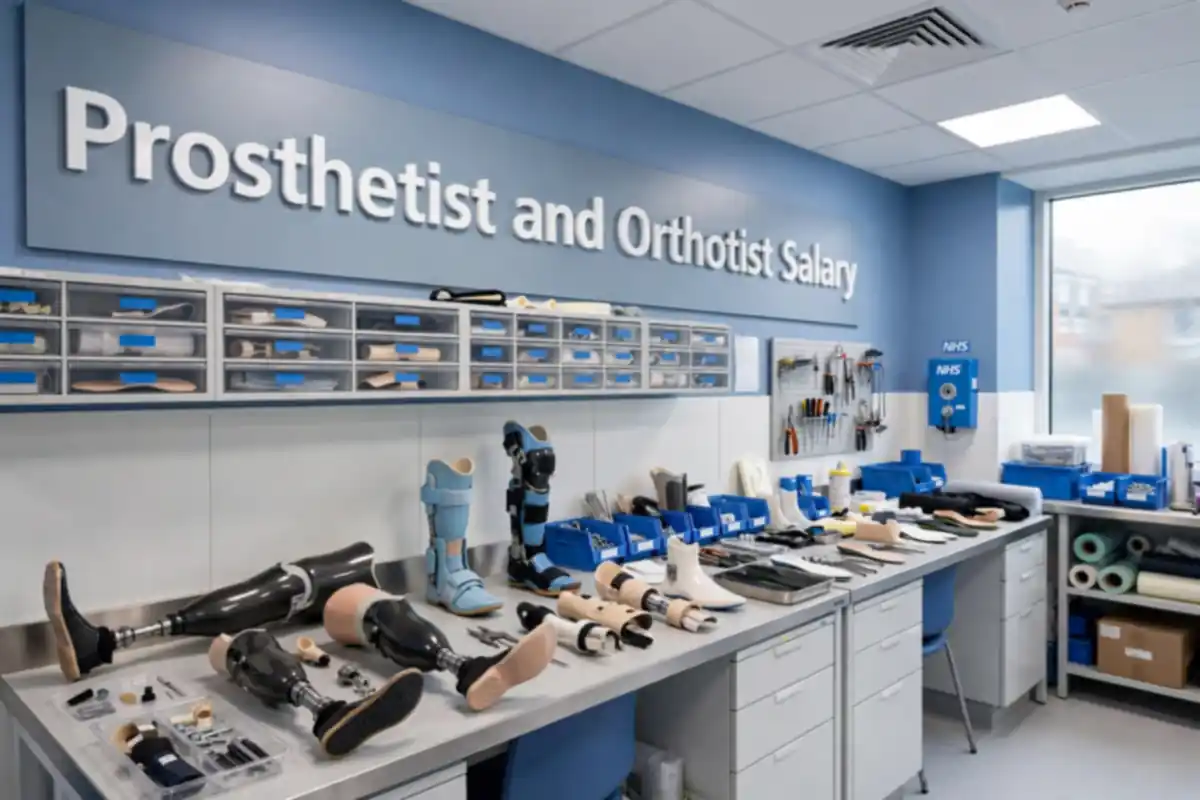
Prosthetist and orthotist pay 2026/27: the Band 5, 6 and 7 scales
England awarded Agenda for Change staff 3.3% from 1 April 2026, and that award is already in these figures. A prosthetist or orthotist in England in 2026/27 earns £32,073 to £39,043 at Band 5, £39,959 to £48,117 at Band 6 and £49,387 to £56,515 at Band 7, for a full-time 37.5-hour week. The step from the top of Band 5 (£39,043) to Band 6 entry (£39,959) is £916, and the step from the top of Band 6 (£48,117) to Band 7 entry (£49,387) is £1,270. Those small gaps at the point of promotion are normal: the gain comes from the wider spread inside the next band, £8,158 from entry to top at Band 6 and £7,128 at Band 7, and from the seniority of the work. For the wider picture at each band, see the Band 5 salary guide, the Band 6 salary guide and the Band 7 salary guide.
The 2026/27 England scales for a full-time 37.5-hour week. Hourly rates are annual pay divided by 52.2 weeks and then by 37.5 hours, rounded to the nearest penny, and enhancement rates on this page are calculated from that rounded hourly rate. Monthly pay is annual pay divided by 12. Weekly pay is annual pay divided by 52.2.
| Band and step | Annual | Monthly | Weekly | Hourly |
|---|---|---|---|---|
| Band 5 entry | £32,073 | £2,672.75 | £614.43 | £16.38 |
| Band 5 intermediate | £34,592 | £2,882.67 | £662.68 | £17.67 |
| Band 5 top | £39,043 | £3,253.58 | £747.95 | £19.95 |
| Band 6 entry | £39,959 | £3,329.92 | £765.50 | £20.41 |
| Band 6 intermediate | £42,170 | £3,514.17 | £807.85 | £21.54 |
| Band 6 top | £48,117 | £4,009.75 | £921.78 | £24.58 |
| Band 7 entry | £49,387 | £4,115.58 | £946.11 | £25.23 |
| Band 7 intermediate | £51,932 | £4,327.67 | £994.87 | £26.53 |
| Band 7 top | £56,515 | £4,709.58 | £1,082.66 | £28.87 |
For comparison, the 2025/26 ranges before the 3.3% award were £31,049 to £37,796 at Band 5, £38,682 to £46,580 at Band 6 and £47,810 to £54,710 at Band 7. The award lifted every step, and no back pay was due in England because the increase was paid on time in April salaries.
What prosthetists and orthotists actually do
A prosthetist works with people who have lost a limb, or were born without one. The job starts with assessment: the shape and condition of the remaining limb, the skin, the range of movement, and what the person needs the limb to do, from walking to work to sport. Then comes the cast or scan, the socket that has to fit snugly without cutting off circulation, the choice of knee, foot or hand component, and the fitting sessions where small adjustments make the difference between a limb that gets worn every day and one that stays in a cupboard. After fitting, the prosthetist reviews the fit as weight, muscle and activity change, and replaces or refits components as they wear. Much of the work happens in a workshop as well as a clinic, and the prosthetist works closely with physiotherapists, who rebuild strength and gait around the new limb, and with rehabilitation consultants and specialist nurses.
An orthotist works with a wider patient group, from children with foot and ankle problems to adults recovering from stroke, spinal injury or surgery. The device might be a foot orthosis inside a shoe, an ankle-foot orthosis that holds the foot up during walking, a spinal brace after surgery, or a knee brace that takes load off a damaged joint. The assessment looks at how the person walks, where pain or instability comes from, and what a device can realistically change. Like prosthetics, the work mixes clinic and workshop: measuring, casting, fitting, and then adjusting when the first version rubs, slips or fails to do the job. A good orthosis is often invisible in daily life, which is the point, and the orthotist hears about it quickly when it is not.
The two professions are often advertised together because they share clinics, workshops and much of their rehabilitation training, and some smaller services employ one practitioner who covers both. Larger services split them, and some posts cover one side only, so read the advert for the caseload rather than the combined job title. Both are allied health professions, and both sit on Agenda for Change, so the national pay scale, not a local market rate, sets the basic salary. For the neighbouring allied health picture, see our podiatrist salary guide and our physiotherapist salary guide.
Band 5, Band 6 and Band 7: what actually changes
At Band 5, a prosthetist or orthotist carries a defined caseload under supervision: their own clinics and fitting sessions, their own measurements and adjustments, and responsibility for the devices they fit, with senior colleagues available for complex cases. Band 5 is where newly qualified practitioners learn the craft that no textbook covers, such as reading a stump that has changed shape since the last fitting, or spotting that a child's orthosis has been outgrown before the child complains about it.
At Band 6, the brief widens to more complex caseloads and to working without routine supervision: multi-joint orthoses, high-activity prosthetic limbs, patients with several conditions interacting at once, and liaison with surgical and rehabilitation teams where the device decision affects the treatment plan. Band 6 practitioners also supervise Band 5 colleagues and students, and take on service tasks such as stock, component choice and clinic scheduling.
At Band 7, the brief widens again to leading a service or a specialty within it: the prosthetics clinic, the paediatric orthotics service or the spinal service, with the rota, the waiting list, the relationship with surgical colleagues and suppliers, and supervision of Band 6 and Band 5 staff. A Band 7 practitioner answers for the quality of the service as well as for their own cases, and handles the referrals where the anatomy, the device options or the patient expectations are hardest. For the Band 7 picture in full, see the Band 7 salary guide.
Unsocial hours, overtime and on-call
Section 2 of Agenda for Change pays time plus 30% for Saturdays and weekday nights (8pm to 6am) and time plus 60% for Sundays and bank holidays, for Bands 4 to 9. Most prosthetic and orthotic work falls in weekday clinic and workshop hours, so unsocial-hours pay is usually a smaller part of the package than it is for ward staff. The exceptions are Saturday clinics, evening fitting sessions run to clear a waiting list, and urgent post-amputation or post-operative work that cannot wait until Monday, and the hours actually worked in those windows attract the enhancement. A 7.5-hour Saturday clinic at Band 5 entry pays £159.68 at the enhanced rate, against £122.85 at plain time, using the rounded hourly rates in the table.
| Band and step | Plain hourly | Sat and weekday nights (+30%) | Sun and bank holidays (+60%) |
|---|---|---|---|
| Band 5 entry | £16.38 | £21.29 | £26.21 |
| Band 5 intermediate | £17.67 | £22.97 | £28.27 |
| Band 5 top | £19.95 | £25.94 | £31.92 |
| Band 6 entry | £20.41 | £26.53 | £32.66 |
| Band 6 intermediate | £21.54 | £28.00 | £34.46 |
| Band 6 top | £24.58 | £31.95 | £39.33 |
| Band 7 entry | £25.23 | £32.80 | £40.37 |
| Band 7 intermediate | £26.53 | £34.49 | £42.45 |
| Band 7 top | £28.87 | £37.53 | £46.19 |
Overtime follows the band, not the job title. At Bands 5 to 7, hours above 37.5 a week are paid at time and a half, and double time on bank holidays. An overtime hour at Band 5 entry is worth £24.57 (£16.38 times 1.5), at the top of Band 6 £36.87, and at the top of Band 7 £43.31. Enhancement and overtime cannot both be claimed for the same hours, and staff may elect time off in lieu instead of overtime pay. On-call is different from both: the payment for being available, as opposed to hours actually worked when called in, is set locally by each trust, so this page quotes no on-call rate. Prosthetic and orthotic services rarely run a formal on-call rota, but where one exists, ask at interview how it works, how often call-ins happen, and how the availability payment is structured in that trust. For the full rules, see our unsocial hours and overtime guide.
London weighting: the HCAS cap binds at the top steps
Prosthetists and orthotists in London trusts receive the High Cost Area Supplement on top of basic pay: 20% of basic in inner London (minimum £5,794, maximum £8,746), 15% in outer London (minimum £4,870, maximum £6,137) and 5% in the fringe zone (minimum £1,346, maximum £2,270). At Band 5 entry the supplement is the percentage figure in inner London (£6,414.60) and the minimum figure in outer London (£4,870), because 15% of £32,073 is £4,810.95, below the outer minimum. From Band 6 intermediate upward the percentage exceeds the maximum in outer London, and from the top of Band 6 upward it exceeds the maximum in inner London too. A prosthetist or orthotist at the top of Band 7 in inner London earns £56,515 + £8,746 = £65,261 a year, and at Band 5 entry in inner London £32,073 + £6,414.60 = £38,487.60. For the full zone rules, see our London weighting guide.
| Post | Basic | Inner London total | Outer London total | Fringe total |
|---|---|---|---|---|
| Band 5 entry | £32,073 | £38,487.60 | £36,943 | £33,676.65 |
| Band 5 intermediate | £34,592 | £41,510.40 | £39,780.80 | £36,321.60 |
| Band 5 top | £39,043 | £46,851.60 | £44,899.45 | £40,995.15 |
| Band 6 entry | £39,959 | £47,950.80 | £45,952.85 | £41,956.95 |
| Band 6 intermediate | £42,170 | £50,604 | £48,307 | £44,278.50 |
| Band 6 top | £48,117 | £56,863 | £54,254 | £50,387 |
| Band 7 entry | £49,387 | £58,133 | £55,524 | £51,657 |
| Band 7 intermediate | £51,932 | £60,678 | £58,069 | £54,202 |
| Band 7 top | £56,515 | £65,261 | £62,652 | £58,785 |
Pension: what comes off the payslip
Prosthetists and orthotists are in the NHS Pension Scheme, and the member contribution is the largest regular deduction after tax. On the provisional 2026/27 England and Wales tiers: Band 5 entry sits in the 8.3% tier at £2,662.06 a year or £221.84 a month on £32,073; Band 5 intermediate sits in the 8.3% tier at £2,871.14 a year or £239.26 a month on £34,592; Band 5 top sits in the 9.8% tier at £3,826.21 a year or £318.85 a month on £39,043; Band 6 entry sits in the 9.8% tier at £3,915.98 a year or £326.33 a month on £39,959; Band 6 intermediate sits in the 9.8% tier at £4,132.66 a year or £344.39 a month on £42,170; Band 6 top sits in the 9.8% tier at £4,715.47 a year or £392.96 a month on £48,117; Band 7 entry sits in the 9.8% tier at £4,839.93 a year or £403.33 a month on £49,387; Band 7 intermediate sits in the 9.8% tier at £5,089.34 a year or £424.11 a month on £51,932; Band 7 top sits in the 10.7% tier at £6,047.11 a year or £503.93 a month on £56,515. The employer contributes 23.7% on top, which is £7,601.30 a year at Band 5 entry and £13,394.06 a year at the top of Band 7. The 2026/27 tiers are provisional, calculated from the published 2025/26 tiers, so treat the tier boundaries as subject to confirmation. For the full tier table, see our pension contributions guide.
Part-time work, leave, mileage and uniform relief
Part-time prosthetic and orthotic work is pro rata of the full-time equivalent salary. A 0.8 WTE practitioner at Band 5 entry earns 80% of £32,073, which is £25,658.40 a year, and a 0.6 WTE practitioner at the top of Band 7 earns 60% of £56,515, which is £33,909.00 a year, before any enhancements. Part-time staff accrue annual leave pro rata, and hours above contracted hours up to 37.5 are paid at plain time plus any unsocial enhancement that applies; only above 37.5 does the overtime rule bite. For the leave rules in full, see our annual leave guide and our part-time pay guide.
Annual leave in England follows the Agenda for Change tiers: 27 days plus 8 bank holidays for up to 4 years of service, 29 plus 8 from 5 years, and 33 plus 8 from 10 years. Some prosthetic and orthotic work involves travel between sites, for example to outreach clinics in other hospitals or to a patient's home, and that travel is claimable under Agenda for Change Section 17. The 2026/27 car rates are 59p a mile for the first 4,500 business miles in the mileage year and 36p a mile above that, with 30p for motorcycles, 20p for pedal cycles and 5p for passengers. A practitioner who drives 4,000 business miles in a year claims 4,000 miles at 59p, a total of £2,360. Travel between home and the normal place of work is not claimable. For the full rates, see our mileage rates guide. Prosthetists and orthotists who wear a uniform, and whose employer provides no laundry service or allowance, can claim HMRC flat-rate expenses for therapists of £125 a year, worth £25 a year at the basic tax rate and £50 at the higher rate, backdatable up to 4 tax years on form P87. Workshop staff who do not wear a uniform cannot claim it.
Pay progression
From prosthetics and orthotics, the next steps are Band 7 service lead posts within rehabilitation, with advanced practice and service-wide leadership as the longer-term direction for those who move beyond direct caseloads. The allied health neighbours at the same bands are covered in our podiatrist salary guide and our physiotherapist salary guide. Band 5 prosthetist and orthotist posts pay £32,073 to £39,043.
Scotland, Wales and Northern Ireland
Scotland has its own Agenda for Change scale and a 36-hour week from April 2026, after a 3.75% award from 1 April 2026. The Scotland Band 5 range is £34,494 to £42,977, which works out at £18.36 to £22.87 an hour on the 36-hour week. Scotland Band 6 and Band 7 steps are not quoted here because the full Scotland scales for those bands are not in the verified data file, and this page does not guess at them. Wales awarded 3.3% from 1 April 2026, and the Wales Band 5 steps are £32,557, £35,114 and £39,631, slightly above the England steps at entry and intermediate. Northern Ireland is different: the 3.3% award was recommended but had not been implemented at the time of writing, so Northern Ireland prosthetists and orthotists should not budget on the new rates until implementation is confirmed. For the nation guides, see NHS Scotland pay, NHS Wales pay and NHS Northern Ireland pay.
The honest picture: hands-on work, nationally set pay
Prosthetist and orthotist pay in 2026/27 is strong, nationally set and transparent: anyone can look up the band, find the step and know the basic salary to the penny, and the ladder runs to Band 7 and beyond £56,000 at the top. What it does not do is pay a premium for the specialism itself. There is no prosthetics supplement in the national Agenda for Change scale, and a prosthetist at Band 6 earns the same basic as a senior nurse at Band 6. The unsocial-hours additions are also smaller here than in ward or on-call specialties for most of the working week, because clinics and workshops run in daytime hours. The value of the role sits elsewhere: in a socket that lets someone walk to work without pain, in a brace that lets a child keep up in the playground, and in the fitting session that turns a device from a piece of equipment into something a person actually wears. When comparing prosthetist and orthotist posts, confirm the band and step, ask whether the post covers prosthetics, orthotics or both, ask how large the caseload is and how much workshop time the post includes, ask about the HCAS zone, and check whether the post carries a service lead brief. Those answers tell you more about the real pay and the real job of a post than the job title alone ever will.
Frequently asked questions
What band is a prosthetist or orthotist in the NHS?
In England in 2026/27, prosthetist and orthotist posts sit mainly at Bands 5, 6 and 7 on Agenda for Change. Band 5 pays £32,073 at entry, £34,592 at the intermediate step and £39,043 at the top. Band 6 pays £39,959 at entry, £42,170 at the intermediate step and £48,117 at the top. Band 7 pays £49,387 at entry, £51,932 at the intermediate step and £56,515 at the top, for a full-time 37.5-hour week. The exact band is set by the job evaluation for each post, so check the advert rather than assuming the band from the title.
What is the difference between a prosthetist and an orthotist?
A prosthetist designs, fits and adjusts artificial limbs for people who have had an amputation or were born without a limb, and reviews the fit as the stump, the socket and the person's activity change. An orthotist designs, fits and adjusts braces, splints and supports, called orthoses, that hold a limb or joint in position, correct alignment, or take load off a painful or unstable joint. The two professions share clinics, workshops and much of their training in rehabilitation, which is why they are often advertised together, but the patient groups and the devices are different, and some posts cover one side only.
How much does a prosthetist or orthotist earn a month?
In England in 2026/27, a full-time prosthetist or orthotist at Band 5 earns £2,672.75 a month at entry, £2,882.67 at the intermediate step and £3,253.58 at the top, before tax, National Insurance and pension deductions. At Band 6 the monthly figures are £3,329.92 at entry, £3,514.17 at the intermediate step and £4,009.75 at the top. At Band 7 they are £4,115.58 at entry, £4,327.67 at the intermediate step and £4,709.58 at the top. Those are gross figures for a full-time 37.5-hour week, before any unsocial-hours enhancement or London weighting.
Do prosthetists and orthotists get unsocial hours pay?
Prosthetists and orthotists are on Agenda for Change, so Section 2 enhancements apply to hours actually worked in the unsocial windows: time plus 30% for Saturdays and weekday nights (8pm to 6am) and time plus 60% for Sundays and bank holidays, for Bands 4 to 9. Most prosthetic and orthotic work falls in weekday clinic and workshop hours, so unsocial-hours pay is usually a smaller part of the package than it is for ward staff. The exceptions are Saturday clinics, evening fitting sessions run to clear a waiting list, and urgent post-amputation or post-operative work that cannot wait until Monday. Overtime above 37.5 hours a week is paid at time and a half at Bands 5 to 7 and double time on bank holidays, and staff may elect time off in lieu instead of overtime pay.
Do prosthetists and orthotists get on-call pay?
Prosthetic and orthotic services rarely run a formal on-call rota, and on-call payments are set locally rather than in the national Agenda for Change scale, so this page quotes no on-call rate. What can be said nationally is that hours actually worked when called in attract the Section 2 enhancement for the window they fall in: time plus 30% for Saturdays and weekday nights and time plus 60% for Sundays and bank holidays at Bands 5 to 7. If a post includes on-call, ask at interview how the rota works, how often call-ins happen, and how the availability payment is structured in that trust, because the local arrangement is what determines the real value of the rota.
Do prosthetists and orthotists get London weighting?
Yes, where the post is based in a London trust. Prosthetists and orthotists receive the High Cost Area Supplement: 20% of basic in inner London (minimum £5,794, maximum £8,746), 15% in outer London (minimum £4,870, maximum £6,137) and 5% in the fringe zone (minimum £1,346, maximum £2,270). At Band 5 entry the supplement is the percentage figure in inner London (£6,414.60) and the minimum figure in outer London (£4,870), because 15% of £32,073 is £4,810.95, below the outer minimum. From Band 6 intermediate upward the percentage exceeds the maximum in outer London, and from the top of Band 6 upward it exceeds the maximum in inner London too, so the supplement is the cap figure there: £8,746 inner, £6,137 outer and £2,270 fringe. A prosthetist or orthotist at the top of Band 7 in inner London earns £56,515 + £8,746 = £65,261 a year, and at Band 5 entry in inner London £32,073 + £6,414.60 = £38,487.60.
How much pension does a prosthetist or orthotist pay?
On the provisional 2026/27 England and Wales tiers, Band 5 entry sits in the 8.3% tier at £221.84 a month on £32,073, Band 5 intermediate sits in the 8.3% tier at £239.26 a month on £34,592, and Band 5 top sits in the 9.8% tier at £318.85 a month on £39,043. Band 6 entry sits in the 9.8% tier at £326.33 a month on £39,959, Band 6 intermediate sits in the 9.8% tier at £344.39 a month on £42,170, and Band 6 top sits in the 9.8% tier at £392.96 a month on £48,117. Band 7 entry sits in the 9.8% tier at £403.33 a month on £49,387, Band 7 intermediate sits in the 9.8% tier at £424.11 a month on £51,932, and Band 7 top sits in the 10.7% tier at £503.93 a month on £56,515. The employer contributes 23.7% on top. The 2026/27 tiers are provisional, calculated from the published 2025/26 tiers, not yet published as final.
Is private prosthetic and orthotic work better paid than the NHS?
Private prosthetic and orthotic work can pay more per clinical hour, but it is usually self-employed or contractor income with no employer pension, paid sick leave or paid annual leave. The NHS package, guaranteed progression through the pay steps, a 23.7% employer pension contribution and 27 to 33 days of annual leave plus bank holidays, is worth thousands a year on top of the salary. Many prosthetists and orthotists do both: an NHS post for security and pension, plus private clinic sessions for extra income. Be wary of anyone quoting private day rates as a salary comparison; compare total reward, not just the hourly figure.