
Perfusionist Salary 2026/27: Band 7-8a
Last updated: 2 November 2026 · Figures verified against the NHS Employers 2026/27 pay circular.
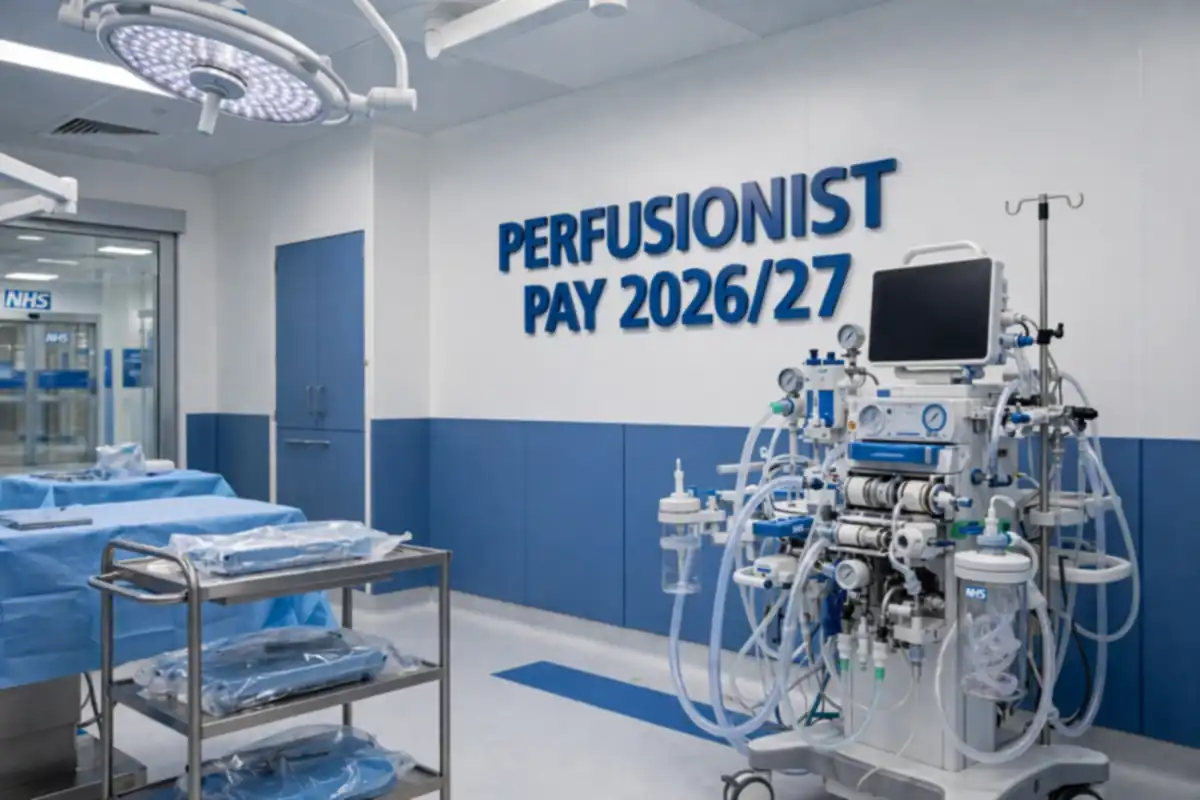
Perfusionist pay 2026/27: the Band 7 and Band 8a scales
England awarded Agenda for Change staff 3.3% from 1 April 2026, and that award is already in these figures. A perfusionist in England in 2026/27 earns £49,387 to £56,515 at Band 7 and £57,528 to £64,750 at Band 8a, for a full-time 37.5-hour week. Perfusion is a small, senior profession: there is no Band 5 or Band 6 perfusionist post in the usual sense, because the training route itself lands graduates at Band 7, and the step to Band 8a is the service-lead or specialist-lead post within a cardiac centre.
The 2026/27 England scales for a full-time 37.5-hour week. Hourly rates are annual pay divided by 52.2 weeks and then by 37.5 hours, rounded to the nearest penny, and enhancement rates on this page are calculated from that rounded hourly rate. Monthly pay is annual pay divided by 12. Weekly pay is annual pay divided by 52.2.
| Band and step | Annual | Monthly | Weekly | Hourly |
|---|---|---|---|---|
| Band 7 entry | £49,387 | £4,115.58 | £946.11 | £25.23 |
| Band 7 intermediate | £51,932 | £4,327.67 | £994.87 | £26.53 |
| Band 7 top | £56,515 | £4,709.58 | £1,082.66 | £28.87 |
| Band 8a entry | £57,528 | £4,794.00 | £1,102.07 | £29.39 |
| Band 8a intermediate | £60,417 | £5,034.75 | £1,157.41 | £30.86 |
| Band 8a top | £64,750 | £5,395.83 | £1,240.42 | £33.08 |
For comparison, the 2025/26 ranges before the 3.3% award were £47,810 to £54,710 at Band 7 and £55,690 to £62,682 at Band 8a. The award lifted every step, and no back pay was due in England because the increase was paid on time in April salaries. The gap between the top of Band 7 (£56,515) and the entry of Band 8a (£57,528) is only £1,013 a year, which surprises people who expect a bigger jump. The real difference between the two bands is not the starting salary: it is the responsibility, the on-call seniority and the ceiling, with Band 8a topping out £8,235 a year above Band 7.
What perfusionists actually do
A perfusionist runs the heart-lung machine, the cardiopulmonary bypass circuit that takes over the work of the heart and lungs while the surgeon operates on a still heart. The job starts before the patient is on bypass. The perfusionist primes the circuit with fluid, checks the oxygenator, pump, filters and monitoring, confirms the cannulation plan with the surgeon, and agrees target flows, temperatures and anticoagulation levels with the anaesthetist. Nothing about this stage is routine in the casual sense: a fault found after bypass starts is far harder to fix than one found during checks.
During bypass, the perfusionist controls blood flow, oxygenation, carbon dioxide removal, temperature and blood pressure through the circuit, watches blood gases and haematocrit, manages anticoagulation, and adjusts as the operation changes. A valve replacement, a coronary bypass and a complex congenital repair each put different demands on the circuit, and the perfusionist reads the case in real time rather than following a fixed script. When the repair is done, the perfusionist weans the patient off bypass in steps, watching how the heart takes over, and hands blood management back to the surgical team.
Outside theatre, the work is maintenance, teaching and service development. Perfusionists service and calibrate machines, keep consumable stocks and circuit records, audit bypass outcomes with the surgical team, and train theatre staff in what the circuit needs from them. In trusts that run an extracorporeal membrane oxygenation (ECMO) service, perfusionists also support ECMO circuits for patients whose heart or lungs need days of support rather than hours, including emergency cannulation out of hours. That ECMO role is a large part of why the on-call rota exists, and why it is busier than in most allied health professions.
The caseload shapes the working pattern. Adult cardiac centres run long elective lists, often with two or three bypass cases in a day, plus emergency cases that arrive without warning. Paediatric and congenital centres add smaller circuits and tighter margins. A perfusionist who dislikes unpredictable hours will struggle with the rota, however good the pay looks on paper, because emergency bypass work does not respect the end of the elective list.
Band 7 and Band 8a: what actually changes
At Band 7, a perfusionist carries their own bypass caseload: elective and emergency cases, their own circuit decisions, and responsibility for the bypass record, working within the centre's protocols and with senior colleagues available for the hardest cases. Band 7 is where newly qualified perfusionists start after the training route, and it is also where most of the profession spends most of its career. The work itself is already senior: the decisions made at the pump affect the patient directly, and there is no junior tier below to hand the circuit to.
At Band 8a, the brief widens to leading the service or a specialty within it: the rota, the on-call seniority, the relationship with surgical and anaesthetic colleagues, the consumable budget, the audit programme, and supervision of Band 7 staff and trainees. A Band 8a perfusionist still runs bypass cases, and in a small centre they may still carry a full caseload, but the post carries accountability for how the whole service runs. That is also why Band 8a overtime is normally taken as time off in lieu rather than paid: the Agenda for Change rule for Bands 8a and above treats the senior salary as covering the extra hours, with time back instead of cash.
Progression beyond Band 8a exists but is thin, because the profession is small and each centre has only a handful of senior posts. The realistic routes are chief perfusionist or service manager posts, consultant-level clinical roles in larger centres, and education or industry roles with device manufacturers. Anyone choosing perfusion for rapid promotion should know the ladder is short: the reward is in the seniority of the Band 7 and 8a work itself, not in a long chain of further bands.
Unsocial hours, overtime and on-call
Section 2 of Agenda for Change pays time plus 30% for Saturdays and weekday nights (8pm to 6am) and time plus 60% for Sundays and bank holidays, for Bands 4 to 9. Cardiac lists run long and emergency work lands at night, so unsocial-hours pay is a larger part of a perfusionist's package than it is for most clinic-based professions. A Saturday list that overruns into the evening, and a Sunday emergency case, both attract the enhancement for the hours actually worked in those windows.
| Band and step | Plain hourly | Sat and weekday nights (+30%) | Sun and bank holidays (+60%) |
|---|---|---|---|
| Band 7 entry | £25.23 | £32.80 | £40.37 |
| Band 7 intermediate | £26.53 | £34.49 | £42.45 |
| Band 7 top | £28.87 | £37.53 | £46.19 |
| Band 8a entry | £29.39 | £38.21 | £47.02 |
| Band 8a intermediate | £30.86 | £40.12 | £49.38 |
| Band 8a top | £33.08 | £43.00 | £52.93 |
Overtime follows the band, not the job title. At Band 7, hours above 37.5 a week are paid at time and a half, and double time on bank holidays. An overtime hour at Band 7 entry is worth £37.85 (£25.23 times 1.5), at the top of Band 7 £43.31, and on a bank holiday at the top of Band 7 £57.74. At Band 8a, overtime is normally taken as time off in lieu rather than paid. Staff may elect time off in lieu instead of overtime pay at Band 7 too, which suits perfusionists who would rather bank the hours than take the cash after a run of long lists.
On-call is where perfusion differs most from other allied health professions. Most cardiac centres run a perfusion on-call rota because emergency surgery and ECMO cannot wait until morning, and the perfusionist on call is the only person in the trust who can run the circuit. The availability payment for being on call is set locally, so this page quotes no rate for it: trusts differ in how they value a night on call, and the only reliable figure is the one in the local rota agreement. Hours actually worked when called in are paid at the Section 2 rates above. A three-hour Sunday call-in at Band 7 entry is worth £121.11 (three hours at the £40.37 Sunday rate), and a four-hour Saturday night call-in at the top of Band 7 is worth £150.12 (four hours at £37.53). A perfusionist weighing a post should ask how often call-ins happen in practice, because a quiet rota and a rota with two call-ins a week are very different jobs at the same basic salary.
London weighting: the HCAS cap binds at every step
Perfusionists in London trusts receive the High Cost Area Supplement on top of basic pay: 20% of basic in inner London (minimum £5,794, maximum £8,746), 15% in outer London (minimum £4,870, maximum £6,137) and 5% in the fringe zone (minimum £1,346, maximum £2,270). At Bands 7 and 8a the percentage exceeds the cap in every zone, so the supplement is the cap figure at every step: £8,746 inner, £6,137 outer and £2,270 fringe. That makes the London maths unusually simple, and it means the supplement is worth proportionally less at Band 8a than at Band 7, because the cap stays fixed while basic pay rises.
| Post | Basic | Inner London total | Outer London total | Fringe total |
|---|---|---|---|---|
| Band 7 entry | £49,387 | £58,133 | £55,524 | £51,657 |
| Band 7 intermediate | £51,932 | £60,678 | £58,069 | £54,202 |
| Band 7 top | £56,515 | £65,261 | £62,652 | £58,785 |
| Band 8a entry | £57,528 | £66,274 | £63,665 | £59,798 |
| Band 8a intermediate | £60,417 | £69,163 | £66,554 | £62,687 |
| Band 8a top | £64,750 | £73,496 | £70,887 | £67,020 |
Read the table as total pay, basic plus supplement. A perfusionist at Band 7 entry in inner London earns £58,133 a year, and at the top of Band 8a in inner London £73,496. In the fringe zone the same two posts pay £51,657 and £67,020. London cardiac centres also tend to carry the heaviest emergency and ECMO rotas, so the supplement should be weighed alongside the on-call load, not on its own.
Pension: what comes off the payslip
Perfusionists are in the NHS Pension Scheme, and the member contribution is the largest regular deduction after tax. On the provisional 2026/27 England and Wales tiers: Band 7 entry sits in the 9.8% tier at £403.33 a month on £49,387; Band 7 intermediate sits in the 9.8% tier at £424.11 a month on £51,932; Band 7 top sits in the 10.7% tier at £503.93 a month on £56,515; Band 8a entry sits in the 10.7% tier at £512.96 a month on £57,528; Band 8a intermediate sits in the 10.7% tier at £538.72 a month on £60,417; and Band 8a top sits in the 10.7% tier at £577.35 a month on £64,750. The employer contributes 23.7% on top, which is £11,704.72 a year at Band 7 entry and £15,345.75 a year at the top of Band 8a. The 2026/27 tiers are provisional, calculated from the published 2025/26 tiers, not yet published as final. For the full tier table and the pension calculator, see the NHS pension contributions guide and the NHS pension calculator.
Part-time work, leave, mileage and uniform relief
Part-time perfusion work is pro rata of the full-time equivalent salary, but part-time rotas are harder to arrange than in clinic-based roles, because the on-call rota needs cover. A 0.8 WTE perfusionist at Band 7 entry earns 80% of £49,387, which is £39,509.60 a year, and a 0.6 WTE perfusionist at the top of Band 8a earns 60% of £64,750, which is £38,850.00 a year, before any enhancements or on-call payments. Anyone seeking part-time perfusion work should confirm the on-call commitment in writing, because a reduced-hours post can still carry a full on-call share in a small team.
Annual leave in England follows the Agenda for Change tiers: 27 days plus 8 bank holidays for up to 4 years of service, 29 plus 8 from 5 years, and 33 plus 8 from 10 years. Perfusionists also need to plan leave around the cardiac list: popular weeks go early, and emergency cover means leave is rarely as flexible as in a clinic post. Some perfusion work involves travel between sites, for example to support a satellite list or an ECMO retrieval, and mileage is paid at the Agenda for Change rates: 59p a mile for the first 4,500 miles a year in a car, then 36p a mile. A perfusionist driving 6,000 miles in a year for work claims £3,195 (4,500 miles at 59p is £2,655, plus 1,500 miles at 36p is £540). Theatre scrubs are normally trust-provided, so uniform tax relief rarely applies in full; where staff buy and wash their own uniform, the HMRC default flat-rate expense is £60 a year, worth £12 a year in tax relief at the basic rate and £24 at the higher rate.
Pay progression
From perfusion, the next steps are Band 8a service-lead posts within the cardiac centre, with chief perfusionist and consultant-level clinical roles as the longer-term direction. The neighbouring theatre nurse pay page shows how the rest of the theatre team is banded, the Band 7 pay scale and Band 8a pay scale pages carry the full scales, and the on-call allowance guide explains how on-call payments work across Agenda for Change. Perfusionists with a science background sometimes move toward the clinical scientist pay ladder, though the two routes are distinct professions.
Scotland, Wales and Northern Ireland
Scotland awarded Agenda for Change staff 3.75% for 2026/27 and moved to a 36-hour working week, which lifts the hourly rate for the same annual salary. Wales awarded 3.3% and applies a Real Living Wage floor that lifts the lowest bands. Northern Ireland has the same 3.3% recommended but not implemented, so staff there should not budget on the uplift until it is confirmed. This page quotes no Scotland or Wales steps for Bands 7 and 8a, because those national step sets are not in the verified data file, and the England figures above should not be relabelled as Scottish or Welsh pay. For the national picture, see the Scotland pay guide, the Wales pay guide and the Northern Ireland pay guide, and for shift maths the unsocial hours and overtime guide.
Frequently asked questions
What band is a perfusionist in the NHS?
In England in 2026/27, clinical perfusionist posts sit mainly at Bands 7 and 8a on Agenda for Change. Band 7 pays £49,387 at entry, £51,932 at the intermediate step and £56,515 at the top. Band 8a pays £57,528 at entry, £60,417 at the intermediate step and £64,750 at the top, for a full-time 37.5-hour week. Senior perfusionists who lead a service or hold a consultant-level clinical role may sit higher, but the advertised band for a standard perfusionist post is Band 7 or Band 8a, and the exact band is set by the job evaluation for each post, so check the advert rather than assuming the band from the title.
What does a perfusionist do during heart surgery?
A perfusionist runs the heart-lung machine that takes over the work of the heart and lungs while the surgeon operates on a still, bloodless heart. Before bypass starts, the perfusionist primes the circuit, checks the oxygenator and pump, and agrees the plan with the surgeon and anaesthetist. During bypass, the perfusionist controls blood flow, oxygenation, temperature and anticoagulation, watches blood gases and pressures, and adjusts the circuit as the operation changes. When the repair is done, the perfusionist weans the patient off bypass in steps, hands blood management back to the surgical team, and records the bypass run. Outside theatre, perfusionists run pre-operative checks, maintain and service the machines, and support extracorporeal membrane oxygenation (ECMO) services where the trust runs one.
How much does a perfusionist earn a month?
In England in 2026/27, a full-time perfusionist at Band 7 earns £4,115.58 a month at entry, £4,327.67 at the intermediate step and £4,709.58 at the top, before tax, National Insurance and pension deductions. At Band 8a the monthly figures are £4,794.00 at entry, £5,034.75 at the intermediate step and £5,395.83 at the top. Those are gross figures for a full-time 37.5-hour week, before any unsocial-hours enhancement, on-call payment or London weighting.
Do perfusionists get on-call pay?
Yes, in most cardiac centres. Perfusion is one of the few allied health professions with a genuine emergency on-call rota, because emergency cardiac surgery and ECMO cannot wait until morning. The availability payment for being on call is set locally rather than in the national Agenda for Change scale, so this page quotes no on-call rate. What is national is the pay for hours actually worked when called in: time plus 30% for Saturdays and weekday nights (8pm to 6am) and time plus 60% for Sundays and bank holidays at Bands 7 and 8a. A three-hour Sunday call-in at Band 7 entry is worth £121.11 (three hours at the £40.37 Sunday rate), and a four-hour Saturday night call-in at the top of Band 7 is worth £150.12 (four hours at £37.53). If a post includes on-call, ask at interview how often call-ins happen and how the availability payment is structured in that trust, because the local arrangement is what determines the real value of the rota.
Do perfusionists get unsocial hours pay?
Perfusionists are on Agenda for Change, so Section 2 enhancements apply to hours actually worked in the unsocial windows: time plus 30% for Saturdays and weekday nights (8pm to 6am) and time plus 60% for Sundays and bank holidays, for Bands 4 to 9. Cardiac lists run long and emergency work lands at night, so unsocial-hours pay is a larger part of a perfusionist's package than it is for most clinic-based professions. Overtime above 37.5 hours a week is paid at time and a half at Band 7 and double time on bank holidays; at Band 8a, overtime is normally taken as time off in lieu rather than paid, following the Agenda for Change rule for Bands 8a and above.
Do perfusionists get London weighting?
Yes, where the post is based in a London trust. Perfusionists receive the High Cost Area Supplement: 20% of basic in inner London (minimum £5,794, maximum £8,746), 15% in outer London (minimum £4,870, maximum £6,137) and 5% in the fringe zone (minimum £1,346, maximum £2,270). At Bands 7 and 8a the percentage exceeds the cap in every zone, so the supplement is the cap figure at every step: £8,746 inner, £6,137 outer and £2,270 fringe. A perfusionist at Band 7 entry in inner London earns £49,387 + £8,746 = £58,133 a year, and at the top of Band 8a in inner London £64,750 + £8,746 = £73,496 a year.
How much pension does a perfusionist pay?
On the provisional 2026/27 England and Wales tiers, Band 7 entry sits in the 9.8% tier at £403.33 a month on £49,387, Band 7 intermediate sits in the 9.8% tier at £424.11 a month on £51,932, and Band 7 top sits in the 10.7% tier at £503.93 a month on £56,515. Band 8a entry sits in the 10.7% tier at £512.96 a month on £57,528, Band 8a intermediate sits in the 10.7% tier at £538.72 a month on £60,417, and Band 8a top sits in the 10.7% tier at £577.35 a month on £64,750. The employer contributes 23.7% on top, which is £15,345.75 a year at the top of Band 8a. The 2026/27 tiers are provisional, calculated from the published 2025/26 tiers, not yet published as final.
Is private perfusion work better paid than the NHS?
Private perfusion work can pay more per case, but it is usually self-employed or contractor income with no employer pension, paid sick leave or paid annual leave, and the caseload is far less predictable than a cardiac centre rota. The NHS package, guaranteed progression through the pay steps, a 23.7% employer pension contribution and 27 to 33 days of annual leave plus bank holidays, is worth thousands a year on top of the salary. Many perfusionists do both: an NHS post for security, pension and regular emergency work, plus private lists for extra income. Be wary of anyone quoting private day rates as a salary comparison; compare total reward, not just the hourly figure.