
NHS Orthopaedic Technician Pay 2026/27: Band 4-5
Last updated: 3 November 2026 · Figures verified against the NHS Employers 2026/27 pay circular.
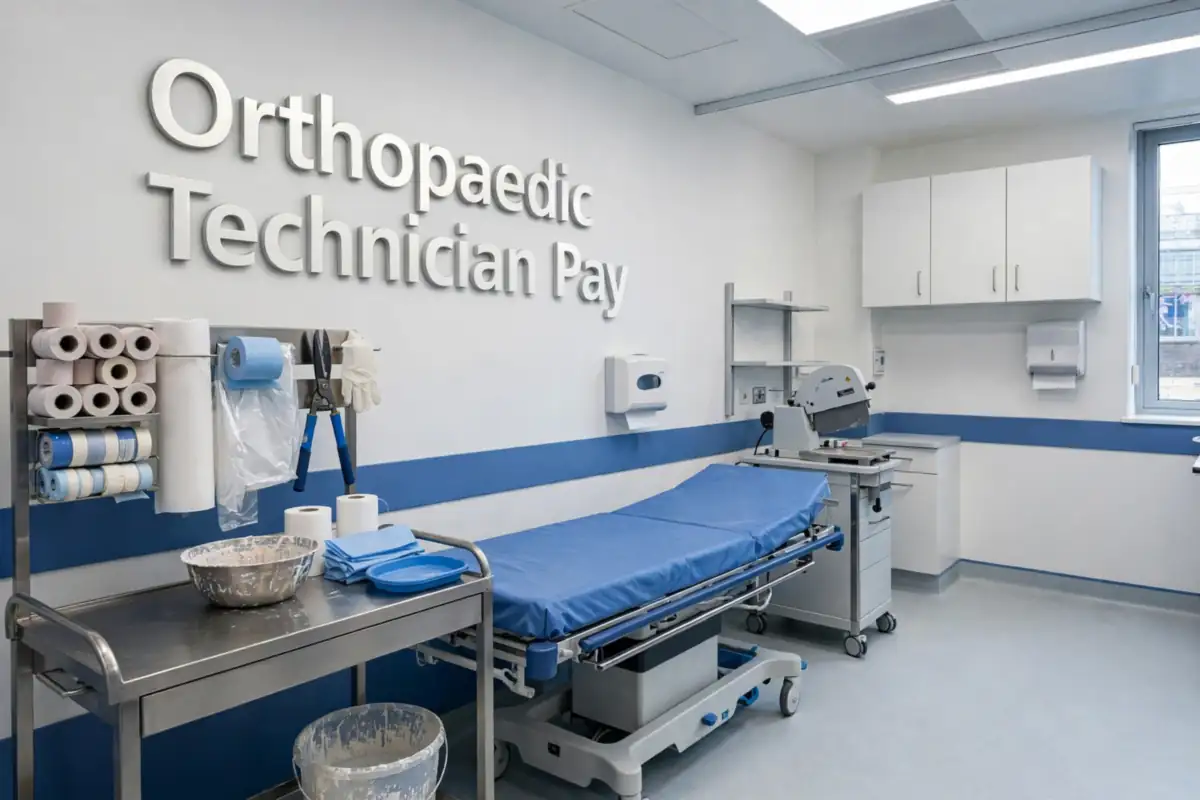
Orthopaedic technician pay 2026/27: the Band 4 and Band 5 scales
England awarded Agenda for Change staff 3.3% from 1 April 2026, and that award is already in these figures. An orthopaedic technician in England in 2026/27 earns £28,392 at Band 4 entry and £31,157 at the top of Band 4, and £32,073 at Band 5 entry, £34,592 at the intermediate step and £39,043 at the top of Band 5, for a full-time 37.5-hour week. Band 4 has two steps, entry and top. Band 5 has three steps, entry, intermediate and top. The gap between the top of Band 4 (£31,157) and the entry of Band 5 (£32,073) is £916 a year, which is small for a promotion, and it tells a useful truth about this ladder: the step from Band 4 to Band 5 is about responsibility, not a large pay jump on day one. The full range on this page, from Band 4 entry to the top of Band 5, is £10,651 a year, and most of that range sits inside Band 5 itself, where the gap from entry to top is £6,970.
The 2026/27 England scales for a full-time 37.5-hour week. Hourly rates are annual pay divided by 52.2 weeks and then by 37.5 hours, rounded to the nearest penny, and enhancement rates on this page are calculated from that rounded hourly rate. Monthly pay is annual pay divided by 12. Weekly pay is annual pay divided by 52.2.
| Band and step | Annual | Monthly | Weekly | Hourly |
|---|---|---|---|---|
| Band 4 entry | £28,392 | £2,366.00 | £543.91 | £14.50 |
| Band 4 top | £31,157 | £2,596.42 | £596.88 | £15.92 |
| Band 5 entry | £32,073 | £2,672.75 | £614.43 | £16.38 |
| Band 5 intermediate | £34,592 | £2,882.67 | £662.68 | £17.67 |
| Band 5 top | £39,043 | £3,253.58 | £747.95 | £19.95 |
Progression within a band is not automatic: it depends on a satisfactory appraisal and completion of statutory and mandatory training. Band 4 moves from entry to top after around two to three years in post, and Band 5 moves through its three steps over a similar span, though the exact timing follows the trust's incremental progression policy. The jump from Band 4 to Band 5 is not a time-served step: it needs a post that carries the senior responsibility, and the post has to be vacant and applied for. A technician who has done Band 5 work for years but sits in a Band 4 post is still paid at Band 4, because Agenda for Change pays the post, not the person.
What orthopaedic technicians actually do
Every fracture clinic depends on this room, and most patients remember the technician better than anyone else in the clinic. A broken wrist, a fractured ankle, a post-operative knee or a child's greenstick fracture all pass through the plaster room at some point. The technician is the person who puts the support on, takes it off, checks what is underneath, and puts a fresh one on when the clinic asks for it. The work looks simple from the waiting room. It is not. A cast has to hold a fracture in the position the surgeon wants, stay comfortable for weeks, and come off without harming the skin. Getting all three right, patient after patient, is a skilled trade.
The day starts with the clinic list. The technician checks which patients need a first cast, which need a cast change, which need a cast removed, and which need a removable splint or brace instead of a full cast. First casts are applied after the clinic team has checked the injury and decided the treatment: the limb is padded, the plaster or synthetic casting material is applied in layers, and the cast is moulded while it sets so it follows the shape of the limb and holds the fracture where it should be. The technician checks circulation, feeling and movement before the patient leaves, and explains how to look after the cast, what swelling to expect, and when to come back urgently.
Cast removal is the other half of the job, and patients dread it more than they need to. The cast saw cuts through plaster and synthetic material without cutting skin, because the blade vibrates rather than spins, but a nervous child or an anxious adult still needs a calm explanation and a steady hand. Once the cast is off, the technician checks the skin, cleans the limb, and helps the clinic team decide what comes next: a fresh cast, a removable splint, a brace, or referral on to physiotherapy for rehabilitation. Removable splints and braces matter more every year, because they let patients wash, exercise and attend physiotherapy while the injury still has support, and fitting one well takes as much judgement as a full cast.
Between patients, the technician keeps the room running: plaster, synthetic casting tape, padding, bandages and stockings restocked; the cast saw and other equipment checked; the room cleaned; and records kept of what was applied to each patient, so the next clinician can see it. The record matters. A patient who returns with a problem needs the clinic to know exactly what cast was applied, when, and by whom, and a room that cannot show its work cannot defend it. The work suits someone who likes hands-on patient contact, visible results and a steady clinic rhythm. It does not suit someone who wants a desk job: the day is spent on your feet, in a warm room, with plaster dust in the air and a list that rarely finishes early.
Band 4 and Band 5: what actually changes
At Band 4, the post is built around competent plaster room work across the full range of routine casts and splints. A Band 4 technician works fracture clinic lists, applies and removes casts to protocol, fits removable splints and braces, and deals with the common problems: a cast that feels tight, a splint that needs adjusting, a patient who needs reassurance about swelling. The technician works with clinic staff on hand, and the harder decisions, such as a complex fracture that needs an unusual cast or a patient whose limb is not behaving as expected, go to the senior technician or the clinic team.
At Band 5, the post leads. A Band 5 technician may run the plaster room on a shift, train and supervise junior technicians, advise clinic staff on casting choices for difficult cases, and take responsibility for the quality of work leaving the room. The work shifts toward judgement and people: covering absence, prioritising urgent trauma cases over routine lists, handling stock and equipment problems, and dealing with patients whose injuries or anxieties need more than a routine cast. A Band 5 post is the usual ceiling for a plaster room career that stays in the room; beyond it, the routes are plaster room management and orthopaedic service lead roles, each a separate post with its own banding rather than an automatic step.
For the wider band ladder, the Band 4 pay guide and the Band 5 pay guide set out what each band means across the NHS, and the technician posts on this page follow that same ladder. The rehabilitation that follows cast removal is covered in the physiotherapist salary guide and the physiotherapy assistant pay guide, because the pathway from plaster room to physiotherapy is the normal journey for most fracture patients.
Shift patterns: clinics, trauma lists and weekend cover
Fracture clinics run mainly on weekdays, and a plaster room attached to a clinic follows that pattern: a steady list of booked patients, a known start and finish, and a room that empties by the evening. Trauma is different. Broken bones arrive at all hours, and larger trusts run weekend plaster room cover for trauma lists and emergency cases, so a technician in a major trauma centre should expect weekend working as part of the rota, while a technician in a smaller unit with weekday-only clinics may rarely work a weekend. That difference is worth checking before accepting a post, because it decides how much enhancement pay is reliable and how much is occasional.
The rota pattern matters as much as the band when comparing two posts. A Band 4 technician on a rota with regular Saturdays earns more in practice than a Band 4 technician on a weekday-only rota in a smaller unit, because every Saturday hour attracts the enhancement. The same applies to late shifts: hours worked after 8pm on weekdays attract the weekday-night enhancement at both bands on this page. Technicians weighing two posts should ask for the rota pattern, not just the band, and should check whether weekend working is rostered or voluntary.
On-call working for out-of-hours trauma is set locally, so this page quotes no rate for it: no national on-call rate for technicians exists in the pay data file, and a rate quoted from one trust would mislead readers in another. Hours actually worked when called in are paid at the plain rate plus the unsocial-hours enhancement for the window worked, on the same basis as the table below.
Unsocial hours and overtime
Section 2 of Agenda for Change pays enhancements for hours actually worked in the unsocial windows: weekdays 8pm to 6am, all Saturday, and Sundays and bank holidays. At Bands 4 to 9 the percentages are the same: time plus 30% for Saturdays and weekday nights and time plus 60% for Sundays and bank holidays. A Saturday hour at Band 4 entry is worth £18.85, against a plain hourly rate of £14.50, and a Sunday hour at the top of Band 5 is worth £31.92. A single Saturday shift of 7.5 hours at Band 5 entry is worth £159.68 at the enhanced rate, against £122.85 at plain time, a difference of £36.83 for that one shift.
| Band and step | Plain hourly | Sat and weekday nights | Sun and bank holidays |
|---|---|---|---|
| Band 4 entry | £14.50 | £18.85 | £23.20 |
| Band 4 top | £15.92 | £20.70 | £25.47 |
| Band 5 entry | £16.38 | £21.29 | £26.21 |
| Band 5 intermediate | £17.67 | £22.97 | £28.27 |
| Band 5 top | £19.95 | £25.94 | £31.92 |
Overtime follows the band. Hours above 37.5 a week are paid at time and a half, and double time on bank holidays, at Bands 4 and 5. An overtime hour at Band 4 entry is worth £21.75 and at the top of Band 4 £23.88. At Band 5 the overtime rates are £24.57 at entry, £26.51 at the intermediate step and £29.93 at the top. On a bank holiday the double-time rates are £29.00 at Band 4 entry and £31.84 at the top of Band 4, and £32.76, £35.34 and £39.90 across the three Band 5 steps. Staff may elect time off in lieu instead of overtime pay, which suits technicians who would rather bank the hours after a heavy weekend. The full rules are on the unsocial hours and overtime guide.
London weighting: the minimum binds at the bottom, not the top
Technicians in London trusts receive the High Cost Area Supplement on top of basic pay: 20% of basic in inner London (minimum £5,794, maximum £8,746), 15% in outer London (minimum £4,870, maximum £6,137) and 5% in the fringe zone (minimum £1,346, maximum £2,270). At Band 4 entry the minimum binds in inner and outer London, so the supplement is £5,794 inner and £4,870 outer, because the raw percentages fall below the minimums. By the top of Band 5 the percentages clear every minimum, so the supplement is £7,808.60 inner, £5,856.45 outer and £1,952.15 fringe. That pattern is worth checking on a payslip: a technician who moves from Band 4 to Band 5 gains basic pay at every step, but the supplement barely moves until the percentages clear the minimums.
| Post | Basic | Inner London total | Outer London total | Fringe total |
|---|---|---|---|---|
| Band 4 entry | £28,392 | £34,186 | £33,262 | £29,811.60 |
| Band 4 top | £31,157 | £37,388.40 | £36,027 | £32,714.85 |
| Band 5 entry | £32,073 | £38,487.60 | £36,943 | £33,676.65 |
| Band 5 intermediate | £34,592 | £41,510.40 | £39,780.80 | £36,321.60 |
| Band 5 top | £39,043 | £46,851.60 | £44,899.45 | £40,995.15 |
Read the table as total pay, basic plus supplement. A technician at Band 4 entry in inner London earns £34,186 a year, and at the top of Band 5 in inner London £46,851.60. In the fringe zone the same two posts pay £29,811.60 and £40,995.15. For the full London weighting rules and the calculator, see the London weighting and HCAS guide and the HCAS calculator.
Pension: the 9.8% tier starts only at the top of Band 5
On the provisional 2026/27 England and Wales tiers, Band 4 entry sits in the 6.5% tier, and the top of Band 4 crosses into the 8.3% tier. At Band 5, entry and the intermediate step sit in the 8.3% tier, and only the top of Band 5 crosses into the 9.8% tier. The employer contributes 23.7% on top of basic pay in every case. The tier is set by whole-time-equivalent salary, so a part-time technician is tiered on the full-time rate for the post, not on part-time earnings, and the monthly contribution below is the full-time figure unless the post is part time.
| Post | Tier | Employee per month | Employer per year |
|---|---|---|---|
| Band 4 entry (£28,392) | 6.5% | £153.79 | £6,728.90 |
| Band 4 top (£31,157) | 8.3% | £215.50 | £7,384.21 |
| Band 5 entry (£32,073) | 8.3% | £221.84 | £7,601.30 |
| Band 5 intermediate (£34,592) | 8.3% | £239.26 | £8,198.30 |
| Band 5 top (£39,043) | 9.8% | £318.85 | £9,253.19 |
The 2026/27 tiers are provisional, calculated from the published 2025/26 tiers, not yet published as final. A technician who crosses the 8.3% to 9.8% boundary, which happens between Band 5 intermediate (£34,592) and Band 5 top (£39,043), will see the monthly contribution jump by more than the pay rise alone suggests: from £239.26 to £318.85 a month. That is normal tier behaviour, not a payroll error. For the full tier table and the calculator, see the pension contributions guide and the pension calculator.
Part time, travel between sites and uniform costs
Part-time working is possible in plaster rooms, because the work is clinic-based and the department needs cover across clinic days. Pay and annual leave are pro rata to the contracted fraction. At 0.8 whole-time equivalent, Band 4 entry pays £22,713.60 a year. At 0.6 whole-time equivalent, the top of Band 5 pays £23,425.80 a year. Hours above contracted hours up to 37.5 a week are paid at plain time, with any unsocial-hours enhancement that applies, and overtime rates only apply above 37.5 hours. Annual leave follows the Agenda for Change tiers: 27 days plus 8 bank holidays at up to 5 years of service, 29 plus 8 at 5 years and over, and 33 plus 8 at 10 years and over, pro rata for part-time staff.
Technicians who travel between sites can claim business mileage under Section 17: 59p a mile for car travel up to 4,500 miles a year, then 36p a mile above that threshold, for journeys on or after 1 July 2026. A technician who drives 4,000 miles in the year claims £2,360, one who drives 5,000 miles claims £2,835, and one who drives 6,000 miles claims £3,195 (59p for the first 4,500 miles, 36p for the remaining 1,500). Mileage is reimbursement for travel costs, not pay, and it is paid separately from salary. Travel between home and the normal workplace is not claimable. The full rates and worked examples are on the mileage rates guide.
Uniform costs are a smaller item. Plaster room staff usually work in trust-provided scrubs, and where the trust provides the scrubs and the laundry service, there is nothing to claim. Where a technician washes a required uniform at home and the employer gives no laundry service or allowance, HMRC flat-rate expenses allow a tax claim. The data-file list does not name orthopaedic technicians separately, so this page does not transfer a named figure across: a technician whose role is not named in the list falls under the default £60 a year, worth £12 a year in tax relief at the basic rate and £24 at the higher rate, claimable for up to four previous tax years.
Scotland, Wales and Northern Ireland
Scotland awarded 3.75% from 1 April 2026 under its two-year deal, and moved to a 36-hour week from April 2026. The data file holds the Scotland Band 5 range, £34,494 to £42,977, but it does not hold Scotland Band 4 steps, so this page does not quote them. On the 36-hour week, the overtime threshold in Scotland is 36 hours rather than 37.5, which changes the overtime maths for part-time and full-time technicians alike. Scotland also has its own nine-tier pension structure, at 5.7% to 12.7%, with thresholds that differ from the England and Wales tiers quoted above.
Wales awarded 3.3%, implemented 1 April 2026 and paid on time. The data file holds the Wales Band 2 spot rate, £26,300, set by the Real Living Wage floor of £13.45 an hour, and gives a Wales Band 5 example of £32,557 at entry, £35,114 at the intermediate step and £39,631 at the top. The data file does not hold Wales Band 4 steps, so this page does not quote them. The Real Living Wage floor applies to the lowest bands in Wales and does not bind at Band 4.
Northern Ireland is different: the 3.3% award was recommended but had not been implemented at the time the data file was last checked, so Northern Ireland technician pay should not be budgeted on the England figures. The Scotland pay guide, the Wales pay guide and the Northern Ireland pay guide carry the nation positions in full.
Is plaster room work a good entry route into the NHS?
For someone who wants hands-on NHS work without a degree, the plaster room is one of the most direct routes in. Most Band 4 posts ask for general education, reliability and the ability to work with patients, rather than a health qualification, and the department trains new starters in post, with competency sign-off for each cast and technique. The work is steady, the clinics are predictable compared with ward work, and the pension, sick pay and annual leave terms are the full Agenda for Change package from the first day.
The trade-offs are honest ones. The work is physical: standing for long clinics, supporting limbs, and working in a warm room near setting plaster. The standards are strict, and a technician who cuts corners will be caught by the clinic team or by the patient returning with a problem, which is the point of the checks. The pay ceiling inside the room is Band 5, and the move beyond it needs a management or service lead post rather than longer service. A technician who wants a clinical career can use the room as a foothold: the hospital experience, the understanding of fracture care and the record of reliable clinic working all help an application for a support role elsewhere, such as the porter pay guide roles or theatre support posts. But the room itself is a career, not just a stepping stone, and the senior technicians who run it are specialists in a craft that fracture clinics cannot do without.
Pay progression
From Band 4 entry (£28,392), the ladder runs through Band 4 top (£31,157) to Band 5 entry (£32,073), Band 5 intermediate (£34,592) and Band 5 top (£39,043), with senior plaster room posts at Band 5 the usual ceiling for a technician career that stays in the room. Beyond Band 5, the routes are plaster room management and orthopaedic service lead roles, each a separate post with its own banding rather than an automatic step. The rehabilitation that follows cast removal is covered in the physiotherapist salary guide, and the wider band ladder is on the Band 4 pay guide and the Band 5 pay guide.
Frequently asked questions
What band is an orthopaedic technician in the NHS?
In England in 2026/27, orthopaedic technicians, also called plaster technicians, sit at Band 4 and Band 5 on Agenda for Change. Band 4 pays £28,392 at entry and £31,157 at the top. Band 5 pays £32,073 at entry, £34,592 at the intermediate step and £39,043 at the top. Those figures are for a full-time 37.5-hour week. Band 4 is the working plaster room grade: applying and removing casts and splints, running fracture clinic lists and keeping the plaster room stocked and safe. Band 5 is the senior grade: leading the plaster room, training junior technicians, handling complex casts and taking responsibility for the quality of work leaving the room. The exact band is set by the job evaluation for each post, so check the advert rather than assuming the band from the job title.
How much does an orthopaedic technician earn a month?
In England in 2026/27, a full-time orthopaedic technician at Band 4 earns £2,366.00 a month at entry and £2,596.42 a month at the top, before tax, National Insurance and pension deductions. At Band 5 the monthly figures are £2,672.75 at entry, £2,882.67 at the intermediate step and £3,253.58 at the top. Those are gross figures for a full-time 37.5-hour week, before any unsocial-hours enhancement, overtime or London weighting. A part-time technician is paid pro rata: at 0.8 whole-time equivalent, Band 4 entry pays £22,713.60 a year, and at 0.6 whole-time equivalent, the top of Band 5 pays £23,425.80 a year.
What does an orthopaedic technician do day to day?
The job is the hands-on casting work behind fracture care. Patients arrive in fracture clinic or the plaster room with a broken bone, a sprain, a post-operative limb or a condition that needs support while it heals. The technician assesses the limb with the clinic team, chooses the right cast, splint or brace, and applies it so it supports the injury without cutting off circulation or pressing on nerves and bony points. The day also includes removing casts with a cast saw, checking the skin underneath, reapplying a fresh cast where the clinic asks for it, and fitting removable splints and braces that patients can take on and off at home. Between patients the technician restocks plaster, bandages and padding, keeps the plaster room clean and ready, checks equipment, and records what was applied so the next clinician can see it. The work is physical, precise and patient-facing: a cast that is too tight, too loose or badly moulded causes real harm, and a well made cast lets a patient get on with healing.
Do orthopaedic technicians work weekends and nights?
Most fracture clinic work happens on weekdays, but orthopaedic trauma does not stop at the weekend, so larger trusts run weekend plaster room cover for trauma lists and emergency cases. Hours worked in the unsocial windows attract Section 2 enhancements: time plus 30% for Saturdays and weekday nights (8pm to 6am) and time plus 60% for Sundays and bank holidays, at both Band 4 and Band 5. A Saturday hour at Band 4 entry is worth £18.85 against a plain hourly rate of £14.50, and a Sunday hour at the top of Band 5 is worth £31.92. Smaller units with weekday-only clinics offer fewer unsocial hours, so the rota pattern matters as much as the band when comparing two posts. On-call cover for out-of-hours trauma is set locally, so this page quotes no on-call rate: no national on-call rate for technicians exists in the pay data file, and a rate quoted from one trust would mislead readers in another.
Do orthopaedic technicians get overtime pay?
Yes, at Bands 4 and 5. Hours above 37.5 a week are paid at time and a half, and double time on bank holidays. An overtime hour at Band 4 entry is worth £21.75 and at the top of Band 4 £23.88. At Band 5 the overtime rates are £24.57 at entry, £26.51 at the intermediate step and £29.93 at the top. On a bank holiday the double-time rates are £29.00 at Band 4 entry and £31.84 at the top of Band 4, and £32.76, £35.34 and £39.90 across the three Band 5 steps. Part-time staff are paid at plain time, plus any unsocial-hours enhancement that applies, for hours above their contracted hours up to 37.5 a week, with overtime rates only above 37.5 hours. Staff may elect time off in lieu instead of overtime pay.
Do orthopaedic technicians get London weighting?
Yes, where the post is based in a London trust. Orthopaedic technicians receive the High Cost Area Supplement: 20% of basic in inner London (minimum £5,794, maximum £8,746), 15% in outer London (minimum £4,870, maximum £6,137) and 5% in the fringe zone (minimum £1,346, maximum £2,270). At Band 4 entry the minimum binds in inner and outer London, so the supplement is £5,794 inner and £4,870 outer, giving totals of £34,186 and £33,262. At the top of Band 5 the percentages clear every minimum, so the supplement is £7,808.60 inner, £5,856.45 outer and £1,952.15 fringe, giving totals of £46,851.60, £44,899.45 and £40,995.15. The supplement follows the base of the post, not the site visited on a given day.
How much pension does an orthopaedic technician pay?
On the provisional 2026/27 England and Wales tiers, Band 4 entry sits in the 6.5% tier, at £153.79 a month on £28,392. The top of Band 4 crosses into the 8.3% tier, at £215.50 a month on £31,157. At Band 5, entry and the intermediate step sit in the 8.3% tier, at £221.84 a month on £32,073 and £239.26 a month on £34,592, and the top of Band 5 sits in the 9.8% tier, at £318.85 a month on £39,043. The employer contributes 23.7% on top, which is £6,728.90 a year at Band 4 entry and £9,253.19 a year at the top of Band 5. The 2026/27 tiers are provisional, calculated from the published 2025/26 tiers, not yet published as final. The tier is set by whole-time-equivalent salary, so a part-time technician is tiered on the full-time rate for the post, not on part-time earnings.
How do you move from Band 4 to Band 5 as an orthopaedic technician?
The route is competency plus a vacant senior post, not time alone. A Band 4 technician builds the full plaster room repertoire: every common cast and splint, cast removal and skin checks, working fracture clinic lists at pace, and handling the awkward cases, such as a swollen limb that needs a split cast or a child who needs patience and a steady hand. Moving to Band 5 usually needs that repertoire plus the senior duties: running the plaster room on a shift, training and supervising junior technicians, advising clinic staff on casting choices, handling stock and equipment problems, and taking responsibility for the quality of work leaving the room. Each move needs a vacant post at the higher band, applied for in the normal way, because Agenda for Change pays the post, not the person. A technician who wants the Band 5 step should ask what competencies the department requires for its senior posts and build those deliberately, rather than waiting for length of service to do the work.
Sources: NHS Employers Agenda for Change pay circular 2026/27; NHS Employers unsocial hours payments; NHS Staff Council mileage mechanism (June 2026); GOV.UK flat-rate expenses list. Figures checked against the site pay data file for 2026/27.