
Ophthalmic Nurse Salary 2026/27: Band 5 to Band 6 Pay Explained
Last updated: 30 October 2026 · Figures verified against the NHS Employers 2026/27 pay circular.
Ophthalmic nursing is the nursing of eyesight: the clinics that test vision and watch chronic eye disease, the theatres where cataracts are removed and retinas are repaired, and the emergency service that sees a patient who has suddenly lost vision in one eye. The nurse in the eye clinic is not a general nurse who happens to work near an eye chart. The work needs a trained eye for subtle change, a steady hand for delicate procedures and a calm manner with patients who are frightened about losing their sight. This page sets out the pay in full, from the Band 5 nurse running clinics to the Band 6 nurse leading the service, with the unsocial hours, on-call, overtime, pension and London weighting figures that actually move the payslip.
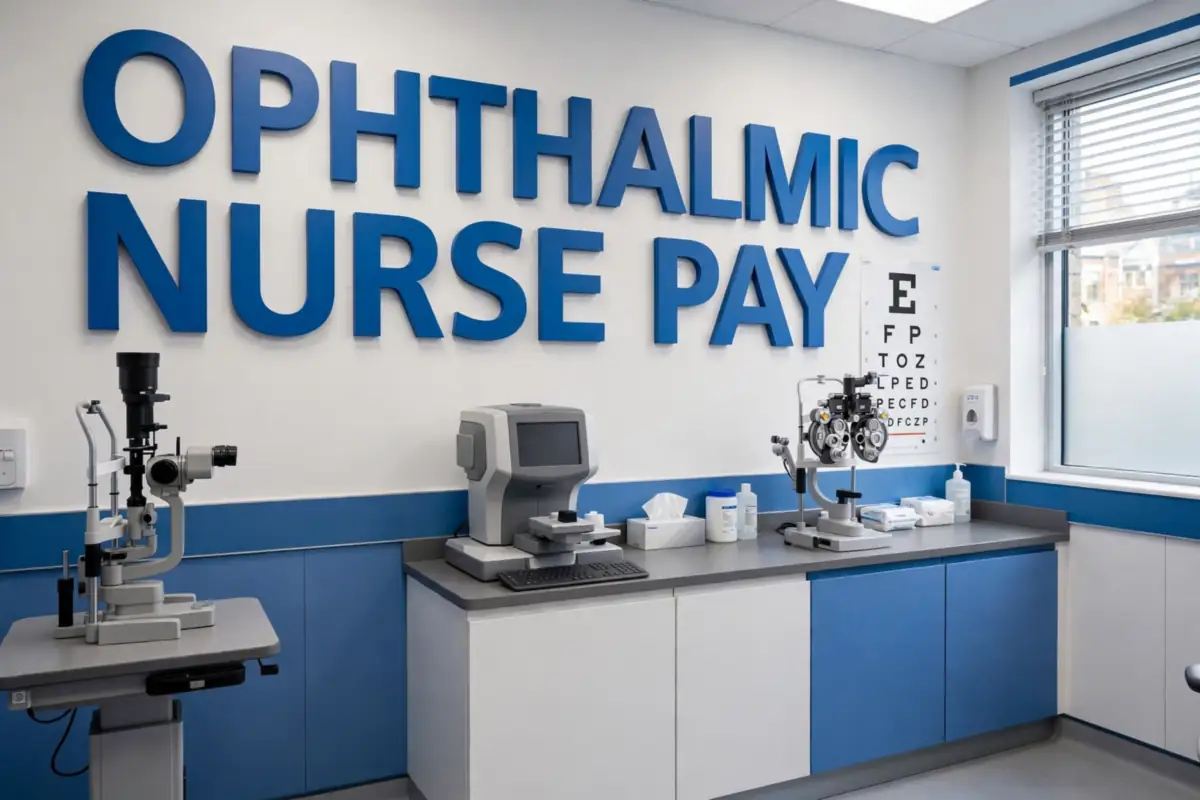
Eye departments have a shape unlike any ward. A clinic is a run of short appointments, each one built around a machine: a visual acuity chart, a slit lamp that magnifies the front of the eye, a machine that photographs the retina, a scanner that maps the layers at the back of the eye. Patients move between rooms and machines, and the nurse moves with them, testing vision, putting in dilating drops, taking measurements and preparing the patient for the doctor or the surgeon. Then there is the theatre side, where the pace changes completely. Cataract lists run fast, with one patient after another, while retinal surgery is slow, precise work that can run long. A nurse who works in ophthalmology needs to be comfortable with both speeds, and the pay follows the band of the post across both settings rather than paying separately for clinic skill and theatre skill.
Ophthalmic nurse pay 2026/27: the Band 5 and Band 6 scales
England awarded Agenda for Change staff 3.3% from 1 April 2026, and the award was paid on time in April salaries. The scales below are the 2026/27 England scales for a full-time 37.5-hour week. Hourly rates are annual pay divided by 52.2 weeks and then by 37.5 hours, which is the standard Agenda for Change conversion. Monthly pay is annual pay divided by 12. For the wider picture at each band, including the roles that share these scales, see the Band 5 salary guide and the Band 6 salary guide.
| Band and step | Annual | Monthly | Weekly | Hourly |
|---|---|---|---|---|
| Band 5 entry | £32,073 | £2,672.75 | £614.43 | £16.38 |
| Band 5 intermediate | £34,592 | £2,882.67 | £662.68 | £17.67 |
| Band 5 top | £39,043 | £3,253.58 | £747.95 | £19.95 |
| Band 6 entry | £39,959 | £3,329.92 | £765.50 | £20.41 |
| Band 6 intermediate | £42,170 | £3,514.17 | £807.85 | £21.54 |
| Band 6 top | £48,117 | £4,009.75 | £921.78 | £24.58 |
The chart above plots the annual figure at each step. The step structure matters for anyone planning a move into the specialty. A nurse appointed to a Band 5 ophthalmic post starts at £32,073 and moves to the intermediate step and then the top through the normal Agenda for Change progression, which is tied to appraisal and time in post rather than to changing jobs. The full journey from Band 5 entry to Band 5 top is worth £6,970 a year, or £580.83 a month, before any enhancements. The step from Band 5 top to Band 6 entry is only £916 a year, and the full journey from Band 6 entry to Band 6 top is worth £8,158 a year. Those small gaps are the honest reality of Agenda for Change: the big rises come from changing bands, not from moving steps, and the steps themselves are worth having but will not transform a salary on their own.
Progression is not instant, and it is worth being honest about the pace. Each band has three steps, and reaching the top takes several years of satisfactory appraisals. An ophthalmic nurse who stays at Band 5 and runs the same clinics year after year will still see pay rise through the steps, but the rises stop at £39,043. After that, the only route to a higher basic is a Band 6 post, which is where the progression section below comes in.
What an ophthalmic nurse actually does
The work splits across three settings, and a nurse who joins an eye department learns all three. The first is the outpatient clinic. This is where most eye patients are seen, and it is where the nurse does the measurements the doctor builds the plan on. Vision testing comes first, then the drops that dilate the pupil, then imaging: photographs of the retina, scans of the layers at the back of the eye, measurements of eye pressure and of the shape of the front of the eye. A nurse who measures well makes the clinic run. A nurse who measures badly sends the doctor back to repeat the work, and the clinic falls behind. Accuracy is not a nice extra in eye clinics. It is the job.
The second setting is theatre. Cataract surgery is the most common operation in the NHS, and ophthalmic theatre nurses run lists that move quickly, with patients in and out in a steady stream and the same steps repeated with care every time. Retinal and corneal surgery is different work: longer cases, finer instruments, a patient who may be awake and anxious under a drape. The theatre nurse prepares the patient, sets up the instruments, supports the surgeon and watches the patient through the case. For the closest neighbouring procedural role, see the theatre nurse salary guide, which covers the Band 5 to Band 7 nurse working in operating theatres.
The third setting is the treatment room, and it has grown fast. Many eye conditions are now treated with injections into the eye, given regularly over months or years, and nurses run these injection clinics and in many services give the injections themselves under agreed protocols. That work needs a nurse who can assess the eye before the injection, carry out the procedure safely, watch for complications afterwards and tell a patient who is nervous about a needle in the eye exactly what will happen. It is skilled, responsible work, and it is now a large share of what eye departments do. None of these three settings carries a separate pay supplement on Agenda for Change. The band of the post covers all of them, which is why the band matters more than any single skill within it.
Becoming an ophthalmic nurse: the route in
Ophthalmic nursing starts with registration. A nurse qualifies, normally in the adult field, and builds clinical experience, often on medical or surgical wards or in theatre recovery, before moving into an eye department. Eye units then look for specialist ophthalmic study on top of that registration, covering eye anatomy, common eye disease, assessment skills and the machines of the clinic. The exact course, entry requirements and funding are set locally by trusts and universities, so a nurse planning the move should check the detail with the unit they want to work in rather than assuming one national route.
One honest point about the study: it helps you get the post, but it does not lift the band on its own. Agenda for Change pays the post, not the certificate. A Band 5 nurse who completes specialist ophthalmic study stays on Band 5 until appointed to a Band 6 post. That can feel unfair given the study involved, and it is worth knowing before committing to a course. The return comes through access: senior, lead and specialist posts go to nurses who hold the specialist knowledge, and the Band 6 figures on this page are the reward for reaching those posts. School nursing is another community-facing specialty nurses sometimes compare with eye work: see the school nurse salary guide for its Band 5 to Band 7 ladder.
Unsocial hours: weekend clinics and evening work
Routine eye clinics run mainly on weekdays, so unsocial hours matter less here than in ward nursing, but they are far from irrelevant. Departments run weekend clinics to clear waiting lists, evening sessions run into the 8pm threshold, and theatre lists can overrun into the evening. Agenda for Change Section 2 pays for those hours. For Bands 4 to 9, which includes Bands 5 and 6, the enhancements are time plus 30% for Saturday and weekday night hours (8pm to 6am) and time plus 60% for Sunday and public-holiday hours. Unsocial hours are counted as any time worked in those windows, not as whole shifts, so an evening clinic that runs to 9pm earns the enhancement for the hour after 8pm. For the full Section 2 rules, see the unsocial hours and overtime guide.
| Band and step | Plain hourly | Saturday / night (+30%) | Sunday / bank holiday (+60%) |
|---|---|---|---|
| Band 5 entry | £16.38 | £21.29 | £26.21 |
| Band 5 intermediate | £17.67 | £22.97 | £28.27 |
| Band 5 top | £19.95 | £25.94 | £31.92 |
| Band 6 entry | £20.41 | £26.53 | £32.66 |
| Band 6 intermediate | £21.54 | £28.00 | £34.46 |
| Band 6 top | £24.58 | £31.95 | £39.33 |
Take a concrete example. A Band 6 ophthalmic nurse at entry works a Saturday clinic of 7.5 hours. At £26.53 an hour, that day pays £198.98, against £153.08 for the same hours on a weekday. A Band 5 nurse at entry working a Sunday of 7.5 hours at £26.21 an hour earns £196.58, against £122.85 on a weekday. Over a year, an ophthalmic nurse who regularly works one weekend clinic a week will see several thousand pounds of enhancement on top of basic pay, which is why two ophthalmic nurses on the same step can take home noticeably different amounts.
On-call: the extra money that defines this specialty
Out-of-hours eye care is the part of the job that most changes the payslip, and it is the part applicants ask about least. Hospitals need an eye team available overnight and at weekends for emergencies: a sudden loss of vision, a detached retina, a chemical splash, a penetrating injury. The team is small, usually one ophthalmologist and one nurse, and it is called in only when needed, which means the rota is disruptive in a particular way: most on-call nights nothing happens, and then one night everything happens at 3am. On-call pay compensates for that disruption, and it has two separate parts that are often confused.
The first part is the availability payment, paid for being on standby whether or not you are called. Where trusts use the national framework, availability is a percentage of basic salary set by rota frequency: 9.5% for rotas of 1 in 3 or more frequent, 4.5% for 1 in 6 to 1 in 3, 3% for 1 in 9 to 1 in 6, and 2% for 1 in 12 to 1 in 9. Many trusts use local flat or sessional rates instead, so the trust policy is the document that matters, not a forum post about another trust. The second part is call-out pay, paid separately for work actually done when called, usually at overtime rates or as time off in lieu. For the full framework, including how travel time and pensionability are treated, see the on-call allowance guide.
| Band and step | Basic | Availability at 9.5% per year | Per month | Availability at 4.5% per year | Per month |
|---|---|---|---|---|---|
| Band 5 entry | £32,073 | £3,046.94 | £253.91 | £1,443.29 | £120.27 |
| Band 5 top | £39,043 | £3,709.09 | £309.09 | £1,756.94 | £146.41 |
| Band 6 entry | £39,959 | £3,796.11 | £316.34 | £1,798.16 | £149.85 |
| Band 6 top | £48,117 | £4,571.12 | £380.93 | £2,165.27 | £180.44 |
Those availability figures are paid on top of basic pay, and call-out pay sits on top again, so a nurse on a frequent rota who is called often can earn well above the basic scale. That is also the honest warning: on-call money is the least predictable part of ophthalmic pay. A quiet year pays the availability figure and little else, while a busy year pays far more, and neither year can be budgeted in advance. Nurses weighing an ophthalmic post should ask three questions before accepting: how frequent is the rota, does the trust pay the national percentages or a local rate, and how is call-out time counted. The answers change the real salary by thousands of pounds.
Overtime: time and a half, double on bank holidays
Overtime in Agenda for Change means hours above 37.5 a week. Part-time ophthalmic nurses are paid at plain time, plus any unsocial enhancement that applies, for hours above their contracted hours up to 37.5; the overtime rates only bite above 37.5. For Bands 1 to 7, overtime is paid at time and a half, and at double time on bank and public holidays. Overtime and unsocial-hours enhancement cannot both be claimed for the same hours, so a nurse picks the better of the two for any given hour, and some staff elect time off in lieu instead of pay.
| Band and step | Plain hourly | Overtime (time and a half) | Bank holiday (double time) |
|---|---|---|---|
| Band 5 entry | £16.38 | £24.57 | £32.76 |
| Band 5 intermediate | £17.67 | £26.51 | £35.34 |
| Band 5 top | £19.95 | £29.93 | £39.90 |
| Band 6 entry | £20.41 | £30.62 | £40.82 |
| Band 6 intermediate | £21.54 | £32.31 | £43.08 |
| Band 6 top | £24.58 | £36.87 | £49.16 |
London weighting: what HCAS adds
The High Cost Area Supplement is paid on top of basic pay in London and the fringe zone. Inner London pays 20% of basic, subject to a minimum of £5,794 and a maximum of £8,746. Outer London pays 15%, with a minimum of £4,870 and a maximum of £6,137. The fringe zone pays 5%, with a minimum of £1,346 and a maximum of £2,270. Where the percentage falls below the minimum, the minimum is paid instead, and where it exceeds the maximum, the payment is capped. For the full HCAS rules, see the London weighting guide.
| Band and step | Basic | Inner London total | Outer London total | Fringe total |
|---|---|---|---|---|
| Band 5 entry | £32,073 | £38,487.60 | £36,943.00 | £33,676.65 |
| Band 5 intermediate | £34,592 | £41,510.40 | £39,780.80 | £36,321.60 |
| Band 5 top | £39,043 | £46,851.60 | £44,899.45 | £40,995.15 |
| Band 6 entry | £39,959 | £47,950.80 | £45,952.85 | £41,956.95 |
| Band 6 intermediate | £42,170 | £50,604.00 | £48,307.00 | £44,278.50 |
| Band 6 top | £48,117 | £56,863.00 | £54,254.00 | £50,387.00 |
The cap bites early at these bands. A Band 5 ophthalmic nurse at entry in inner London receives the full 20%, which is £6,414.60, but a Band 6 nurse at the top is already capped: 20% of £48,117 is £9,623.40, so the payment is held at £8,746. In outer London, the Band 6 entry payment of £5,993.85 sits just inside the £6,137 maximum, while the intermediate step (15% of £42,170 is £6,325.50) and the top step (15% of £48,117 is £7,217.55) are both capped at £6,137, so the outer London payment stops rising with the step above entry. In the fringe zone, the Band 5 entry figure of £1,603.65 sits inside the range and is paid in full, while the Band 6 top is capped at £2,270. London weighting lifts the payslip, but at Band 5 and Band 6 it lifts it by a fixed maximum rather than by a straight percentage for most steps.
One check worth doing by hand: the Band 5 intermediate inner total is £41,510.40, because 20% of £34,592 is £6,918.40, which sits inside the £5,794 to £8,746 range and is paid in full. The Band 6 intermediate inner total is £50,604.00, because 20% of £42,170 is £8,434, which also sits inside the range. Caps only bite where the percentage runs past the maximum, and the table shows exactly where that happens.
Pension: what comes off the payslip
NHS pension contributions in England and Wales for 2026/27 are provisional, calculated from the published tier structure rather than yet published as a final table, and the figures below use those provisional tiers. Band 5 ophthalmic nurses at entry and the intermediate step fall in the 8.3% tier, which covers pensionable pay from £28,855 to £35,155, while Band 5 nurses at the top fall in the 9.8% tier, which covers £35,156 to £52,778. All Band 6 ophthalmic nurses fall in the 9.8% tier. The employer adds 23.7% on top of basic pay. For the full tier table, see the pension contributions guide.
| Band and step | Annual | Tier | Employee per month | Employer per year |
|---|---|---|---|---|
| Band 5 entry | £32,073 | 8.3% | £221.84 | £7,601.30 |
| Band 5 intermediate | £34,592 | 8.3% | £239.26 | £8,198.30 |
| Band 5 top | £39,043 | 9.8% | £318.85 | £9,253.19 |
| Band 6 entry | £39,959 | 9.8% | £326.33 | £9,470.28 |
| Band 6 intermediate | £42,170 | 9.8% | £344.39 | £9,994.29 |
| Band 6 top | £48,117 | 9.8% | £392.96 | £11,403.73 |
Part-time pay is pro rata, and the maths is simple enough to check on a payslip. A Band 5 ophthalmic nurse at entry working 0.6 whole-time equivalent earns 60% of £32,073, which is £19,243.80 a year. A Band 6 ophthalmic nurse at the top working 0.8 whole-time equivalent earns 80% of £48,117, which is £38,493.60 a year. Unsocial-hours enhancements, on-call availability and London weighting are then calculated on the part-time basic in the same way, and pension contributions follow the tier that the whole-time equivalent salary falls in, not the part-time figure alone, so a part-time nurse should check the tier against the full-time salary for the post. The part-time pay guide works through the full pro rata rules.
Pay progression
From Band 5, the natural next step is a Band 6 senior ophthalmic nurse post, running clinics, supervising the Band 5 team and taking responsibility for the smooth running of a clinic or a theatre list. From Band 6, the route leads to unit lead and nurse specialist roles where the trust offers them, and to the wider specialist ladder covered in the clinical nurse specialist salary guide. The step from Band 5 top to Band 6 entry is £916 a year, and the full journey from Band 6 entry to Band 6 top is worth £8,158 a year. For the Band 5 scale itself, see the Band 5 salary guide, and for Band 6, the Band 6 salary guide. Nurses weighing the move should also read the theatre nurse salary guide, which covers the closest neighbouring procedural role, and the endoscopy nurse salary guide, which covers the other on-call-heavy procedural specialty at Bands 5 to 6.
Annual leave, uniform relief and the smaller extras
Annual leave under Agenda for Change Section 13 in England is 27 days plus 8 bank holidays for staff with up to 4 years of service, 29 days plus 8 for 5 or more years, and 33 days plus 8 for 10 or more years. Part-time ophthalmic nurses receive the same entitlement pro rata. A nurse working 0.6 whole-time equivalent with 5 years of service receives 60% of 37 days, which is 22.2 days. Leave is counted in hours for staff on varied shifts, and ophthalmic nurses should check how their trust counts leave, because the two methods give different answers for part-time rotas. The annual leave guide covers the hours conversion and the mid-year starter rules.
Uniform tax relief is a small but reliable extra. Nurses, midwives, healthcare assistants, therapists, radiographers, physiotherapists and dental nurses can claim a flat-rate expense of £125 a year for laundering a uniform, which is worth £25 a year in tax relief at the basic rate and £50 at the higher rate. It is claimed through a tax code change rather than through payroll, so it never appears on a payslip, but it is real money for an ophthalmic nurse who washes scrubs at home. The tax code guide explains how to claim it.
Scotland, Wales and Northern Ireland
Scotland awarded 3.75% from 1 April 2026 and moved to a 36-hour full-time week, with its own pay scale. Wales awarded 3.3% and paid it on time, with its own scale that differs slightly from England. This page quotes no Scotland or Wales Band 6 ophthalmic figure, because the verified data file holds only the national awards and the Band 5 comparison points: Scotland Band 5 runs from £34,494 at entry to £42,977 at the top, and Wales Band 5 runs from £32,557 at entry to £39,631 at the top. Northern Ireland has a 3.3% recommendation for 2026/27 that had not been implemented as of late August 2026, so this page quotes no Northern Ireland figure. Ophthalmic nurses in the devolved nations should check the national scale for their nation rather than applying the England figures on this page. For the national hubs, see NHS Scotland pay, NHS Wales pay and NHS Northern Ireland pay.
The honest picture: what ophthalmic nurse pay does and does not do
Ophthalmic nurse pay is solid, transparent and nationally set, which is its strength. A nurse can look up the band scale, add the unsocial-hours percentage for the rota, add the on-call availability for the rota frequency, and know the gross figure within a few pounds. There are no hidden bonuses and no negotiation over the basic: the scale is the scale. The weakness is the ceiling. Band 5 tops out at £39,043, and a nurse who wants more must move to Band 6, which means running clinics and supervising others, and beyond that the route narrows to the small number of lead posts in a department. Eye work also carries demands that other nursing does not: the pace of a clinic, the responsibility of a patient under a drape in theatre, and the 3am call-out for a patient who may be losing their sight. The on-call money compensates for the disruption, but it does not compensate for the rest, and any nurse weighing a move into ophthalmology should spend time in an eye department first. The pay is fair for the band. The work is the reason to take it, not the salary.
Frequently asked questions
What band is an ophthalmic nurse?
Most ophthalmic nurses sit at Band 5 or Band 6. In England in 2026/27, Band 5 pays £32,073 at entry, £34,592 at the intermediate step and £39,043 at the top, and Band 6 pays £39,959 at entry, £42,170 at the intermediate step and £48,117 at the top. The band follows the post, not the job title, so a nurse running eye clinics and a nurse leading the eye unit can sit at different bands in the same trust.
How much does an ophthalmic nurse earn a month?
In England in 2026/27, a Band 5 ophthalmic nurse earns £2,672.75 a month at entry, £2,882.67 at the intermediate step and £3,253.58 at the top, before tax, National Insurance and pension deductions and before any unsocial-hours enhancement, on-call payment or London weighting. A Band 6 ophthalmic nurse earns £3,329.92 to £4,009.75 a month. Those are gross figures for a full-time 37.5-hour week.
Do ophthalmic nurses get unsocial-hours pay?
Yes, when the hours are worked. Agenda for Change Section 2 pays Bands 4 to 9 time plus 30% for Saturday and weekday night hours (8pm to 6am) and time plus 60% for Sunday and public-holiday hours. A Band 5 ophthalmic nurse at entry earns £21.29 an hour on a Saturday or at night and £26.21 on a Sunday or bank holiday, against £16.38 plain time. At the top of Band 6, £24.58 an hour becomes £31.95 and £39.33. Most routine eye clinics run on weekdays, so unsocial-hours money in this specialty comes mainly from weekend clinics, theatre lists and on-call work.
Do ophthalmic nurses get on-call pay?
Yes, where the eye service runs an out-of-hours emergency service for urgent cases such as a sudden loss of vision, a detached retina or a chemical injury to the eye. On-call pay has two parts: an availability payment for being on standby and call-out pay for work actually done when called. Where trusts use the national framework, availability is a percentage of basic salary set by rota frequency: 9.5% for rotas of 1 in 3 or more frequent, 4.5% for 1 in 6 to 1 in 3, 3% for 1 in 9 to 1 in 6, and 2% for 1 in 12 to 1 in 9. Many trusts use local flat or sessional rates instead, so check the trust policy. A Band 6 ophthalmic nurse at entry on a 1-in-3 rota under the national framework receives £3,796.11 a year in availability pay, or £316.34 a month.
Do ophthalmic nurses get overtime pay?
Yes, for hours above 37.5 a week. Bands 1 to 7 are paid time and a half for overtime and double time on bank and public holidays. A Band 6 ophthalmic nurse at the top of the band earns £36.87 an hour for overtime and £49.16 on a bank holiday, against £24.58 plain time. Part-time nurses are paid at plain time, plus any unsocial enhancement that applies, for hours above their contracted hours up to 37.5; the overtime rates only bite above 37.5. Overtime and unsocial-hours enhancement cannot both be claimed for the same hours.
How much is London weighting for an ophthalmic nurse?
The High Cost Area Supplement is 20% of basic pay in inner London (minimum £5,794, maximum £8,746), 15% in outer London (minimum £4,870, maximum £6,137) and 5% in the fringe zone (minimum £1,346, maximum £2,270). A Band 5 ophthalmic nurse at entry in inner London receives £6,414.60 on top of the £32,073 basic, for a total of £38,487.60. A Band 6 ophthalmic nurse at the top in inner London is capped at the £8,746 maximum, for a total of £56,863. Where the percentage falls below the minimum, the minimum is paid instead.
What pension contribution does an ophthalmic nurse pay?
Under the provisional 2026/27 tiers, Band 5 ophthalmic nurses at entry and the intermediate step pay 8.3% of pensionable pay, which is £221.84 and £239.26 a month, and Band 5 nurses at the top pay 9.8%, which is £318.85 a month. All Band 6 ophthalmic nurses pay 9.8%, which is £326.33 a month at entry, £344.39 at the intermediate step and £392.96 at the top. The employer adds 23.7% on top, which is £7,601.30 a year at Band 5 entry and £11,403.73 a year at the top of Band 6.
How does ophthalmic nurse pay differ in Scotland and Wales?
Scotland awarded 3.75% from 1 April 2026 and moved to a 36-hour full-time week, with its own pay scale. Wales awarded 3.3% and paid it on time, with its own scale that differs slightly from England. This page quotes no Scotland or Wales Band 6 ophthalmic figure, because the verified data file holds only the national awards and the Band 5 comparison points: Scotland Band 5 runs from £34,494 at entry to £42,977 at the top, and Wales Band 5 runs from £32,557 at entry to £39,631 at the top. Northern Ireland has a 3.3% recommendation for 2026/27 that had not been implemented as of late August 2026, so this page quotes no Northern Ireland figure.
Source: NHS Employers unsocial hours payments. Pay figures: NHS Employers Agenda for Change pay circular 2026/27.