
Mammographer Salary 2026/27: Band 5-7 Pay
Last updated: 2 November 2026 · Figures verified against the NHS Employers 2026/27 pay circular.
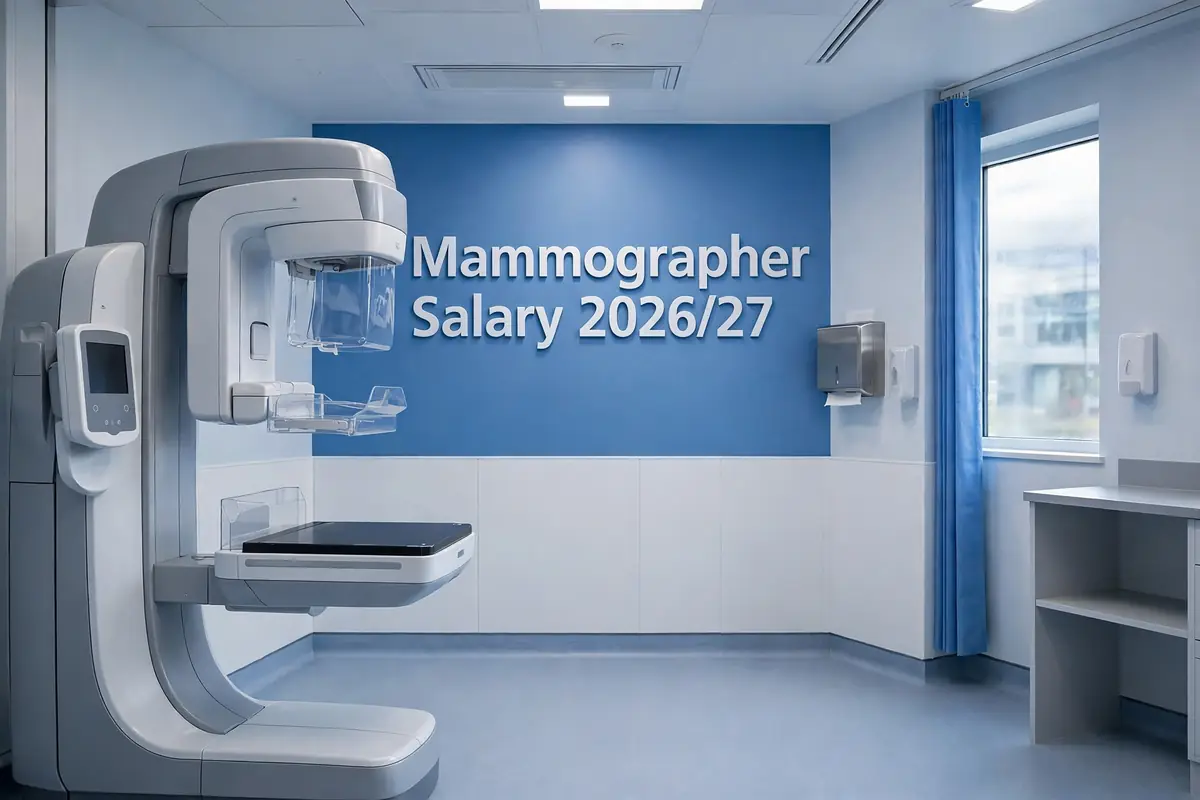
Mammographer pay 2026/27: the Band 5, 6 and 7 scales
England awarded Agenda for Change staff 3.3% from 1 April 2026, and that award is already in these figures. A mammographer in England in 2026/27 earns £32,073 to £39,043 at Band 5, £39,959 to £48,117 at Band 6 and £49,387 to £56,515 at Band 7, for a full-time 37.5-hour week. The step from the top of Band 5 (£39,043) to Band 6 entry (£39,959) is £916, and the step from the top of Band 6 (£48,117) to Band 7 entry (£49,387) is £1,270. Both promotion gaps look small on paper. The real gain from promotion is the wider spread inside the higher band: £8,158 from entry to top at Band 6, and £7,128 from entry to top at Band 7, plus the seniority and reporting responsibility that comes with the post. For the wider picture at each band, see the Band 5 salary guide, the Band 6 salary guide and the Band 7 salary guide.
The 2026/27 England scales for a full-time 37.5-hour week. Hourly rates are annual pay divided by 52.2 weeks and then by 37.5 hours, rounded to the nearest penny, and enhancement rates on this page are calculated from that rounded hourly rate. Monthly pay is annual pay divided by 12. Weekly pay is annual pay divided by 52.2.
| Band and step | Annual | Monthly | Weekly | Hourly |
|---|---|---|---|---|
| Band 5 entry | £32,073 | £2,672.75 | £614.43 | £16.38 |
| Band 5 intermediate | £34,592 | £2,882.67 | £662.68 | £17.67 |
| Band 5 top | £39,043 | £3,253.58 | £747.95 | £19.95 |
| Band 6 entry | £39,959 | £3,329.92 | £765.50 | £20.41 |
| Band 6 intermediate | £42,170 | £3,514.17 | £807.85 | £21.54 |
| Band 6 top | £48,117 | £4,009.75 | £921.78 | £24.58 |
| Band 7 entry | £49,387 | £4,115.58 | £946.11 | £25.23 |
| Band 7 intermediate | £51,932 | £4,327.67 | £994.87 | £26.53 |
| Band 7 top | £56,515 | £4,709.58 | £1,082.66 | £28.87 |
For comparison, the 2025/26 ranges before the 3.3% award were £31,049 to £37,796 at Band 5, £38,682 to £46,580 at Band 6 and £47,810 to £54,710 at Band 7. The award lifted every step, and no back pay was due in England because the increase was paid on time in April salaries.
What mammographers actually do
A mammographer produces the images that breast diagnosis depends on. The examination itself looks simple from the waiting room: the patient stands at the machine, the breast is positioned and gently compressed, and the image is taken. Doing it well is a skilled, physical job. Positioning has to include the whole breast tissue while keeping the patient as comfortable as compression allows, and the image has to be sharp, correctly exposed and free of artefacts, or it has to be repeated. A repeat examination means extra radiation and extra anxiety for the patient, so getting it right first time matters in a way that is not true of every imaging modality.
The two sides of the work feel different even though the machine is the same. Screening work is planned and list-based: a run of routine examinations in a screening unit or a mobile unit, with a steady pace, standard views and a quality assurance routine that checks every image before the patient leaves. Symptomatic work is clinic-based and varied: patients referred with a lump, pain, nipple change or another symptom, imaged as part of an assessment clinic alongside surgeons, radiologists and breast care nurses, where the images may lead to further imaging, biopsy or a treatment plan the same day. Some mammographers work in both settings, and some posts are screening-only or symptomatic-only, so the mix is worth checking in the advert. For the general radiography picture, see our radiographer salary guide, and for the ultrasound-led diagnostic picture, see our sonographer salary guide.
Patients in a mammography department are often anxious, and some are in pain. Screening patients may be attending for the first time and unsure what compression feels like. Symptomatic patients may be frightened about what the images will show. The mammographer has to explain the examination clearly, keep the patient still and calm enough for a usable image, and handle the result pathway sensitively, without speculating about a diagnosis that is not theirs to give. That patient-facing skill, plus the technical judgement about image quality, is what separates an experienced mammographer from a newly qualified one, and it is one reason the senior posts sit at Band 6 and the reporting posts at Band 7.
Mammography is also a team discipline. Images are read by radiologists and by reporting mammographers, and the quality of the reading depends on the quality of the image. A mammographer who positions consistently, spots a technical fault before the patient leaves, and flags a clinical concern through the right route makes the whole service safer. Quality assurance runs through the job: regular checks on the equipment, on image quality and on repeat rates, and audit work that feeds back into training. In a small specialty, where a department may have only a handful of mammographers, that shared responsibility for standards is part of daily work, not an occasional extra.
Band 5, Band 6 and Band 7: what actually changes
At Band 5, a mammographer carries a defined caseload under supervision: their own screening lists and symptomatic clinic sessions, their own standard examinations and image quality checks, and responsibility for the images they produce, with senior colleagues available for difficult positioning, complex cases and quality queries. Band 5 is where a newly qualified mammographer learns the parts of the job that no textbook covers, such as positioning a patient with limited mobility, or getting a diagnostic image from a patient who is in pain and cannot hold still for long.
At Band 6, the brief widens to more complex caseloads and to working without routine supervision: symptomatic clinic lists where the imaging plan adapts to the clinical question, screening lists where the mammographer is trusted to manage the session, and liaison with radiologists and surgeons where the imaging plan affects the assessment plan. Band 6 mammographers also supervise Band 5 colleagues and students, run quality checks on the department output, and take on service tasks such as clinic scheduling, equipment checks and audit.
At Band 7, the brief widens again to advanced practice and reporting. Reporting mammographers read and report mammograms, taking clinical responsibility for the report that the treating team acts on. Band 7 posts may also carry a lead brief for a screening unit, a symptomatic service or a mobile unit programme, in which case the rota, the waiting list and the relationship with referring specialties sit with that mammographer. Reporting qualifications underpin the Band 7 advanced roles, and they are the single most valuable pay lever in the specialty: they are what turns a senior mammographer into an advanced practitioner. For the Band 7 picture in full, see the Band 7 salary guide.
Unsocial hours, overtime and Saturday clinics
Section 2 of Agenda for Change pays time plus 30% for Saturdays and weekday nights (8pm to 6am) and time plus 60% for Sundays and bank holidays, for Bands 4 to 9. Most mammography work falls in weekday clinic hours, so unsocial-hours pay is usually a smaller part of the package than it is for staff on 24-hour rotas. The main exception is Saturday working: some screening and symptomatic services run Saturday clinics to clear waiting lists, and the hours actually worked on a Saturday attract time plus 30%. A 7.5-hour Saturday clinic at Band 5 entry pays £159.68 at the enhanced rate, against £122.85 at plain time, using the rounded hourly rates in the table. Evening sessions, where a service runs them, attract the same treatment for hours after 8pm.
| Band and step | Plain hourly | Sat and weekday nights (+30%) | Sun and bank holidays (+60%) |
|---|---|---|---|
| Band 5 entry | £16.38 | £21.29 | £26.21 |
| Band 5 intermediate | £17.67 | £22.97 | £28.27 |
| Band 5 top | £19.95 | £25.94 | £31.92 |
| Band 6 entry | £20.41 | £26.53 | £32.66 |
| Band 6 intermediate | £21.54 | £28.00 | £34.46 |
| Band 6 top | £24.58 | £31.95 | £39.33 |
| Band 7 entry | £25.23 | £32.80 | £40.37 |
| Band 7 intermediate | £26.53 | £34.49 | £42.45 |
| Band 7 top | £28.87 | £37.53 | £46.19 |
Overtime follows the band, not the job title. At Bands 5 to 7, hours above 37.5 a week are paid at time and a half, and double time on bank holidays. An overtime hour at Band 5 entry is worth £24.57 (£16.38 times 1.5), at the top of Band 5 £29.93, at Band 6 entry £30.62, and at the top of Band 7 £43.31. Enhancement and overtime cannot both be claimed for the same hours, and staff may elect time off in lieu instead of overtime pay. On-call is a smaller feature of mammography than of general radiography, because breast imaging rarely needs an overnight emergency service, and any on-call availability payment is set locally by each trust, so this page quotes no on-call rate. For the full rules, see our unsocial hours and overtime guide.
London weighting: the HCAS minimum and cap both bite
Mammographers in London trusts receive the High Cost Area Supplement on top of basic pay: 20% of basic in inner London (minimum £5,794, maximum £8,746), 15% in outer London (minimum £4,870, maximum £6,137) and 5% in the fringe zone (minimum £1,346, maximum £2,270). At Band 5 entry the supplement is the percentage figure in inner London and the fringe, because 20% of £32,073 is £6,414.60 and 5% is £1,603.65, both inside their zone limits, but in outer London 15% is £4,810.95, below the £4,870 minimum, so the minimum applies. From Band 6 intermediate upward the percentage exceeds the maximum in outer London, and from the top of Band 6 it exceeds the maximum in inner London too, while the fringe cap binds from the top of Band 6 upward. A mammographer at the top of Band 7 in inner London earns £56,515 + £8,746 = £65,261 a year, and at Band 5 entry in inner London £32,073 + £6,414.60 = £38,487.60. For the full zone rules, see our London weighting guide.
| Post | Basic | Inner London total | Outer London total | Fringe total |
|---|---|---|---|---|
| Band 5 entry | £32,073 | £38,487.60 | £36,943 | £33,676.65 |
| Band 5 intermediate | £34,592 | £41,510.40 | £39,780.80 | £36,321.60 |
| Band 5 top | £39,043 | £46,851.60 | £44,899.45 | £40,995.15 |
| Band 6 entry | £39,959 | £47,950.80 | £45,952.85 | £41,956.95 |
| Band 6 intermediate | £42,170 | £50,604 | £48,307 | £44,278.50 |
| Band 6 top | £48,117 | £56,863 | £54,254 | £50,387 |
| Band 7 entry | £49,387 | £58,133 | £55,524 | £51,657 |
| Band 7 intermediate | £51,932 | £60,678 | £58,069 | £54,202 |
| Band 7 top | £56,515 | £65,261 | £62,652 | £58,785 |
Pension: what comes off the payslip
Mammographers are in the NHS Pension Scheme, and the member contribution is the largest regular deduction after tax. On the provisional 2026/27 England and Wales tiers: Band 5 entry sits in the 8.3% tier at £2,662.06 a year or £221.84 a month on £32,073; Band 5 intermediate sits in the 8.3% tier at £2,871.14 a year or £239.26 a month on £34,592; Band 5 top sits in the 9.8% tier at £3,826.21 a year or £318.85 a month on £39,043; Band 6 entry sits in the 9.8% tier at £3,915.98 a year or £326.33 a month on £39,959; Band 6 intermediate sits in the 9.8% tier at £4,132.66 a year or £344.39 a month on £42,170; Band 6 top sits in the 9.8% tier at £4,715.47 a year or £392.96 a month on £48,117; Band 7 entry sits in the 9.8% tier at £4,839.93 a year or £403.33 a month on £49,387; Band 7 intermediate sits in the 9.8% tier at £5,089.34 a year or £424.11 a month on £51,932; Band 7 top sits in the 10.7% tier at £6,047.11 a year or £503.93 a month on £56,515. The employer contributes 23.7% on top, which is £7,601.30 a year at Band 5 entry and £13,394.06 a year at the top of Band 7. The 2026/27 tiers are provisional, calculated from the published 2025/26 tiers, so treat the tier boundaries as subject to confirmation. For the full tier table, see our pension contributions guide.
Part-time work, leave, mileage and uniform relief
Part-time mammographer work is pro rata of the full-time equivalent salary. A 0.8 WTE mammographer at Band 5 entry earns 80% of £32,073, which is £25,658.40 a year, and a 0.6 WTE mammographer at the top of Band 7 earns 60% of £56,515, which is £33,909 a year, before any enhancements. Part-time staff accrue annual leave pro rata, and hours above contracted hours up to 37.5 are paid at plain time plus any unsocial enhancement that applies; only above 37.5 does the overtime rule bite. For the leave rules in full, see our annual leave guide and our part-time pay guide.
Annual leave in England follows the Agenda for Change tiers: 27 days plus 8 bank holidays for up to 4 years of service, 29 plus 8 from 5 years, and 33 plus 8 from 10 years. Mammographers who travel between sites, for example to mobile units or outreach clinics in other hospitals, claim that travel under Agenda for Change Section 17. The 2026/27 car rates are 59p a mile for the first 4,500 business miles in the mileage year and 36p a mile above that, with 30p for motorcycles, 20p for pedal cycles and 5p for passengers. A mammographer who drives 4,000 business miles in a year claims £2,360, and one who drives 5,000 business miles claims 4,500 miles at 59p plus 500 miles at 36p, a total of £2,835. Travel between home and the normal place of work is not claimable. For the full rates, see our mileage rates guide. Mammographers who wear a uniform, and whose employer provides no laundry service or allowance, may be able to claim HMRC flat-rate expenses: the default rate for a uniformed job not otherwise listed is £60 a year, worth £12 a year at the basic tax rate and £24 at the higher rate. Check which rate fits the post rather than assuming one applies, and note the claim can be backdated up to 4 tax years on form P87.
Pay progression
From mammography, the next steps are Band 6 senior posts within a screening unit or symptomatic service, then Band 7 advanced practitioner and reporting posts, with unit lead and service manager posts as the longer-term direction for those who move beyond direct caseloads. The neighbouring imaging picture is covered in our radiographer salary guide and our sonographer salary guide. Band 5 mammographer posts pay £32,073 to £39,043.
Scotland, Wales and Northern Ireland
Scotland has its own Agenda for Change scale and a 36-hour week from April 2026, after a 3.75% award from 1 April 2026. The Scotland Band 5 range is £34,494 to £42,977, which works out at £18.36 to £22.87 an hour on the 36-hour week. Scotland Band 6 and Band 7 steps are not quoted here because the full Scotland scales for those bands are not in the verified data file, and this page does not guess at them. Wales awarded 3.3% from 1 April 2026, and the Wales Band 5 steps are £32,557, £35,114 and £39,631, which work out at £16.63, £17.94 and £20.25 an hour on a 37.5-hour week. Wales Band 6 and Band 7 steps are likewise not quoted, for the same reason. Northern Ireland is different: the 3.3% award was recommended but had not been implemented at the time of writing, so Northern Ireland mammographers should not budget on the new rates until implementation is confirmed. For the nation guides, see NHS Scotland pay, NHS Wales pay and NHS Northern Ireland pay.
The honest picture: small specialty, exacting standards
Mammographer pay in 2026/27 is nationally set and transparent: anyone can look up the band, find the step and know the basic salary to the penny, and the ladder runs to £56,515 at the top of Band 7. What it does not do is pay a premium for the specialism itself. There is no mammography supplement in the national Agenda for Change scale, and a mammographer at Band 7 earns the same basic as a senior nurse at Band 7. The unsocial-hours additions are also smaller here than in ward or on-call specialties for most of the working week, because breast imaging runs in daytime hours. The value of the role sits elsewhere: in an image sharp enough to settle a diagnosis without a repeat examination, in a screening list run well enough that patients leave reassured rather than worried, and in a symptomatic clinic where the imaging helps the team reach a plan the same day. When comparing mammographer posts, confirm the band and step, ask how much of the list is screening and how much is symptomatic, ask about mobile unit work and Saturday clinics, ask about the HCAS zone, and check whether the post carries a reporting brief. Those answers tell you more about the real pay and the real job of a post than the job title alone ever will.
Frequently asked questions
What band is a mammographer in the NHS?
In England in 2026/27, mammographer posts sit mainly at Bands 5, 6 and 7 on Agenda for Change. Band 5 pays £32,073 at entry, £34,592 at the intermediate step and £39,043 at the top. Band 6 pays £39,959 at entry, £42,170 at the intermediate step and £48,117 at the top. Band 7 pays £49,387 at entry, £51,932 at the intermediate step and £56,515 at the top, for a full-time 37.5-hour week. Newly qualified mammographers start at Band 5, senior mammographers sit at Band 6, and advanced practitioners, including reporting mammographers, sit at Band 7. The exact band is set by the job evaluation for each post, so check the advert rather than assuming the band from the title.
What does a mammographer do?
A mammographer takes mammograms: low-dose X-ray images of breast tissue. The work has two sides. In breast screening, mammographers work through planned lists of routine examinations, often in a screening unit or a mobile unit, producing the images that the screening programme then reads and reports. In symptomatic clinics, mammographers image patients who have been referred with a symptom, such as a lump or pain, working alongside surgeons, radiologists and breast care nurses in a clinic where the images feed into same-day assessment and diagnosis. In both settings the mammographer positions the patient, sets the exposure, checks the image quality before the patient leaves, and records the examination. A poor image means a repeat examination or a missed finding, so positioning skill and image quality control are the core of the job.
How is a mammographer different from a radiographer?
A mammographer is a diagnostic radiographer who has specialised in breast imaging. The registration is the same, and the pay ladder is the same Agenda for Change ladder: Band 5 on qualification, Band 6 for senior roles and Band 7 for advanced practice. The difference is the modality. General radiographers rotate through plain film, CT, MRI and other imaging, while mammographers work in breast imaging alone, building the positioning, compression and image quality judgement that breast work demands. For the general radiography picture, see our radiographer salary guide.
How much does a mammographer earn a month?
In England in 2026/27, a full-time mammographer at Band 5 earns £2,672.75 a month at entry, £2,882.67 at the intermediate step and £3,253.58 at the top, before tax, National Insurance and pension deductions. At Band 6 the monthly figures are £3,329.92 at entry, £3,514.17 at the intermediate step and £4,009.75 at the top. At Band 7 they are £4,115.58 at entry, £4,327.67 at the intermediate step and £4,709.58 at the top. Those are gross figures for a full-time 37.5-hour week, before any unsocial-hours enhancement or London weighting.
Do mammographers get unsocial hours pay?
Mammographers are on Agenda for Change, so Section 2 enhancements apply to hours actually worked in the unsocial windows: time plus 30% for Saturdays and weekday nights (8pm to 6am) and time plus 60% for Sundays and bank holidays, for Bands 4 to 9. Most mammography work falls in weekday clinic hours, so unsocial-hours pay is usually a smaller part of the package than it is for staff on 24-hour rotas. The exceptions are Saturday screening or symptomatic clinics, which some services run to clear waiting lists, and any evening sessions, where the hours actually worked attract the enhancement for that window. A 7.5-hour Saturday clinic at Band 5 entry pays £159.68 at the enhanced rate, against £122.85 at plain time, using the rounded hourly rates in the table. Overtime above 37.5 hours a week is paid at time and a half at Bands 5 to 7 and double time on bank holidays, and staff may elect time off in lieu instead of overtime pay.
Do mammographers work in mobile screening units?
Some mammographers do, and it is worth asking about at interview because it changes the working week. Mobile units take screening to sites away from the main hospital, so a post that includes mobile work involves travel between sites, setting up and checking the unit, and working away from the base department for part of the week. Travel between sites on trust business is claimable under Agenda for Change Section 17, while travel between home and the normal place of work is not. The 2026/27 car rates are 59p a mile for the first 4,500 business miles in the mileage year and 36p a mile above that. A mammographer who drives 4,000 business miles in a year claims £2,360. Mobile work does not carry its own national pay supplement: the pay follows the band, the step and the HCAS zone, as for hospital-based posts.
Do mammographers get London weighting?
Yes, where the post is based in a London trust. Mammographers receive the High Cost Area Supplement: 20% of basic in inner London (minimum £5,794, maximum £8,746), 15% in outer London (minimum £4,870, maximum £6,137) and 5% in the fringe zone (minimum £1,346, maximum £2,270). At Band 5 entry the supplement is the percentage figure in inner London and the fringe, because 20% of £32,073 is £6,414.60 and 5% is £1,603.65, both inside their zone limits, but in outer London 15% is £4,810.95, below the £4,870 minimum, so the minimum applies and the total is £36,943. From Band 6 intermediate upward the percentage exceeds the maximum in outer London, and from the top of Band 6 it exceeds the maximum in inner London too, so the supplement is the cap figure there. A mammographer at the top of Band 7 in inner London earns £56,515 + £8,746 = £65,261 a year, and at Band 5 entry in inner London £32,073 + £6,414.60 = £38,487.60.
How much pension does a mammographer pay?
On the provisional 2026/27 England and Wales tiers, Band 5 entry sits in the 8.3% tier at £221.84 a month on £32,073, Band 5 intermediate sits in the 8.3% tier at £239.26 a month on £34,592, and Band 5 top sits in the 9.8% tier at £318.85 a month on £39,043. Every Band 6 step sits in the 9.8% tier: £326.33 a month on £39,959 at entry, £344.39 a month on £42,170 at the intermediate step, and £392.96 a month on £48,117 at the top. Band 7 entry sits in the 9.8% tier at £403.33 a month on £49,387, Band 7 intermediate sits in the 9.8% tier at £424.11 a month on £51,932, while Band 7 top sits in the 10.7% tier at £503.93 a month on £56,515. The employer contributes 23.7% on top. The 2026/27 tiers are provisional, calculated from the published 2025/26 tiers, not yet published as final.