
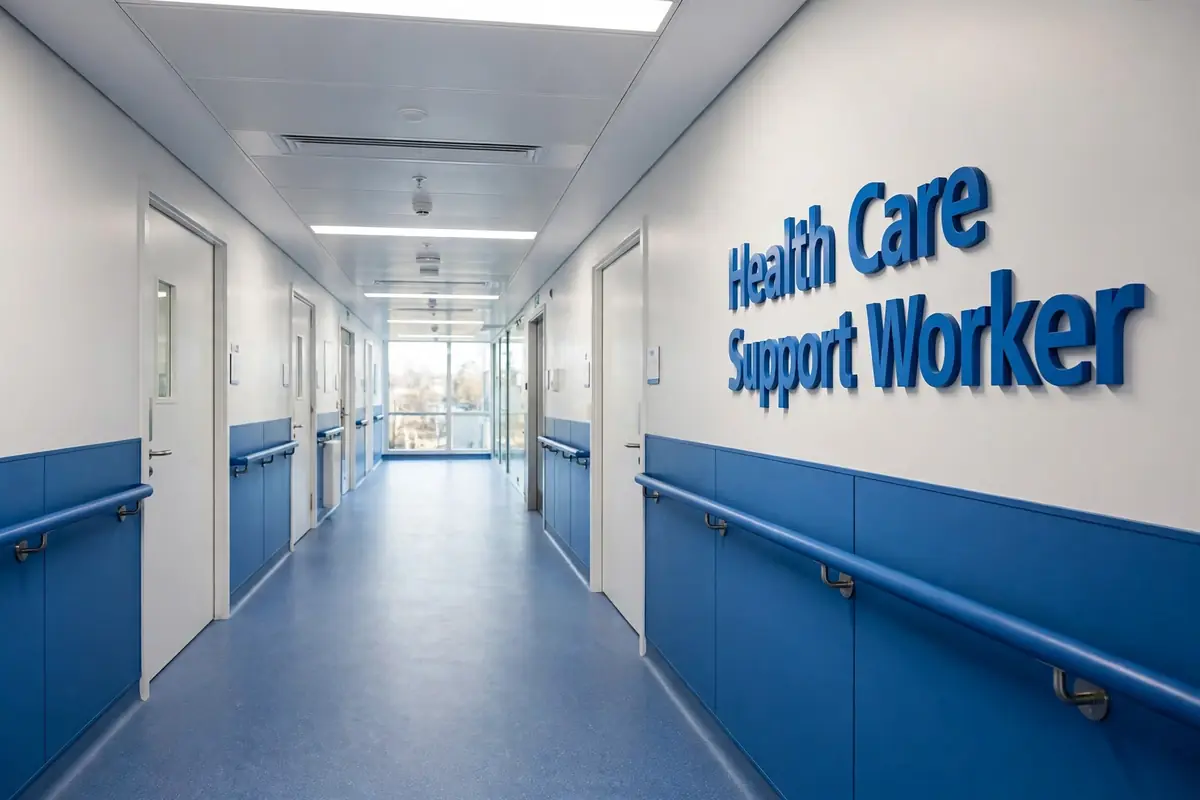
Health Care Support Worker Job at Midlands Partnership: Band 2, £25,272
Last updated: 27 November 2026 · Vacancy verified live on NHS Jobs on 27 November 2026.
Key facts
| Detail | This vacancy |
|---|---|
| Job title | Band 2 Health Care Support Worker |
| Employer | Midlands Partnership NHS Foundation Trust |
| Location | The Redwoods Centre, Somerby Drive, Shrewsbury, SY3 8DS |
| Band | Band 2, Agenda for Change |
| Salary | £25,272 a year, pro rata |
| Contract | Permanent |
| Working pattern | Full-time, part-time; shift patterns covering 24/7 |
| Date posted | 19 November 2026 |
| Closing date | 17 December 2026 |
| Reference | 301-SB-26-8443968 |
| Apply | Official advert on NHS Jobs |
Pay breakdown: what the salary really means
Band 2 is the simplest band in Agenda for Change to explain, because it has a single spot rate rather than a ladder of pay steps. In England in 2026/27 every Band 2 post pays £25,272 a year full-time, whether you are in your first week or your fifth year. The advertised figure matches that spot rate exactly, which is how we know the advert is quoting the current national scale and not an older one. There is no London weighting on top: Shrewsbury is outside the HCAS zones, so the £25,272 is the whole basic salary. For the background to the band, see our Band 2 pay guide.
Because the advert offers part-time hours, the table below shows the full-time salary and three common part-time fractions. Pro rata simply means the annual salary scales with your contracted hours: at 0.6 whole-time equivalent (WTE), which is 22.5 hours a week on a 37.5-hour full-time week, the basic salary is 60% of £25,272. The hourly rate stays the same at every fraction.
| Hours | Annual salary | Monthly gross | Hourly rate | Take-home per month |
|---|---|---|---|---|
| Full-time (37.5 hours) | £25,272 | £2,106.00 | £12.92 | £1,700.11 |
| 0.8 WTE (30 hours) | £20,217.60 | £1,684.80 | £12.92 | £1,418.75 |
| 0.6 WTE (22.5 hours) | £15,163.20 | £1,263.60 | £12.92 | £1,137.38 |
| 0.5 WTE (18.75 hours) | £12,636 | £1,053.00 | £12.92 | £997.80 |
Hourly rates are annual salary divided by 52.143 weeks divided by 37.5 hours. Take-home figures assume no student loan and England income tax; see the take-home table below. Enhancements for nights, weekends and bank holidays are not included in these basic figures.
Take-home pay, worked through
Gross salary is not what lands in your bank account. The table below works through the deductions in the order they apply: the NHS pension contribution first, then income tax on what is left after the pension and the £12,570 personal allowance, then National Insurance, which is charged on the full gross pay at 8% between £12,570 and £50,270. The pension tier is set by your actual annual pensionable pay, so a part-time support worker can sit in a lower tier than a full-time colleague on the same band. At full-time, £25,272 falls in the £13,260 to £28,854 tier, which pays 6.5%. At 0.5 WTE, actual pay of £12,636 falls in the lowest tier, which pays 5.2%, and there is no income tax to pay because the salary after pension sits below the personal allowance.
| Hours | Gross | Pension | Income tax | National Insurance | Take-home per year | Take-home per month |
|---|---|---|---|---|---|---|
| Full-time | £25,272 | £1,642.68 | £2,211.86 | £1,016.16 | £20,401.30 | £1,700.11 |
| 0.8 WTE | £20,217.60 | £1,314.14 | £1,266.69 | £611.81 | £17,024.96 | £1,418.75 |
| 0.6 WTE | £15,163.20 | £985.61 | £321.52 | £207.46 | £13,648.61 | £1,137.38 |
| 0.5 WTE | £12,636 | £657.07 | £0 | £5.28 | £11,973.65 | £997.80 |
The pension line deserves a second look, because it is easy to read it as money lost. The 6.5% contribution at full-time is £1,642.68 a year, and the trust adds an employer contribution of 23.7% of pensionable pay, which is £5,989.46 a year, or £499.12 a month, on top of your salary. Each year of service builds pension at 1/54 of that year's pay, so a full year at £25,272 adds £468.00 a year of pension, revalued over time. Our NHS pension contributions guide explains the tiers in full, and our healthcare assistant take-home pay guide works through the same maths for support roles generally.
Unsocial hours and overtime on a 24/7 rota
The basic figures above are only the starting point for this post, because the advert states that the role works shift patterns covering 24/7. Adult acute wards do not close at weekends, so a support worker on these wards will work a share of nights, Saturdays, Sundays and bank holidays, and Agenda for Change pays enhancements for those hours. Band 2 has the highest enhancement percentages of any band: time plus 41% for Saturdays and weekday nights, and time plus 83% for Sundays and public holidays. On the £12.92 hourly rate, that is £18.22 an hour for a Saturday or night hour and £23.64 an hour for a Sunday or bank holiday hour.
To see what that means on a real shift, take a 12-hour Saturday shift. At plain time it pays £155.04; at the enhanced rate it pays £218.64, which is £63.60 more for the same shift. A 12-hour Sunday shift pays £283.68, which is £128.64 more than plain time. Overtime above 37.5 hours a week is paid at time-and-a-half, £19.38 an hour, and double time on bank holidays, £25.84 an hour, although an hour cannot attract both overtime and an unsocial-hours enhancement. For part-timers, hours above contracted hours up to 37.5 are paid at plain time, with the unsocial enhancement where it applies, and overtime rates only begin above 37.5 hours. The full rules are in our unsocial hours and overtime guide. The practical point for budgeting is that a support worker on a 24/7 rota usually takes home noticeably more than the basic £1,700.11 a month, with the exact figure set by the rota.
What the role involves
This is a ward-based support role in the adult acute mental health service at The Redwoods Centre. The service runs three mixed-gender inpatient wards, Pine, Birch and Laurel, for adults aged 18 upwards who need hospital care for acute mental health problems. Acute wards are fast-moving places: people arrive in crisis, stay for assessment and treatment, and move on when they are well enough, so the patient group changes constantly and no two shifts look the same.
The heart of the job is time spent with patients. Each support worker spends therapeutic time with an allocated group of service users, building the relationships that make people feel safe enough to engage with their care. The work supports each person's recovery through care that is measured against outcomes and grounded in evidence, and it is done alongside the registered professionals on the ward: support workers help put individual care plans into practice and feed back on how each person is doing. That feedback is a formal part of the role, not an afterthought. Support workers record service users' health status and care aims in care records and report verbally to registered staff and the wider multidisciplinary team, including while supporting section 136 assessments and ECT treatment. In plain terms, what you observe on the ward, and how clearly you report it, shapes the decisions the clinical team makes.
It is worth being honest about the setting, as the advert is: acute mental health work can be challenging, and it asks for a positive attitude and resilience as well as compassion. The trust frames the role around engagement, recovery and positive care, and around improving each patient's experience of a difficult time. For many support workers this is exactly the appeal: the work is close to patients, it is varied, and it is a recognised first step into mental health nursing and the wider NHS. Our healthcare assistant salary guide explains how support roles progress from Band 2 upwards.
Who can apply
The advert sets out the following essential criteria. If you cannot evidence all of them, the application is unlikely to get through shortlisting:
- Level 2 Diploma in Health and Social Care, or NVQ 2 in Health and Social Care, with demonstrable evidence of numeracy and literacy skills (GCSEs or Functional Skills equivalent).
- Demonstrable knowledge and experience relevant to the role.
- Experience of working as part of a team and delivering a customer focused service.
Two further points are listed as desirable rather than essential: experience of working with people with mental health needs as part of a multidisciplinary team, and experience of being a service user or carer. Desirable criteria do not decide shortlisting on their own, but they are worth evidencing if you have them, because they speak directly to this ward setting. Note what the essential list does not require: there is no demand for previous NHS employment, and the customer focused service experience can come from outside healthcare. What matters is evidencing the qualification, the numeracy and literacy, and the team-based service experience with concrete examples.
About Midlands Partnership NHS Foundation Trust
Midlands Partnership NHS Foundation Trust employs around 9,000 staff. It provides physical and mental healthcare, support for people with learning disabilities, and adult social care across Staffordshire, Stoke-on-Trent, Shropshire and Telford and Wrekin. Alongside those local services it runs regional and national services, including perinatal care for new parents, eating disorders services, forensic services, sexual health, and support for people in prison with mental health, drug or alcohol problems.
For a support worker, the breadth of the trust matters in practical terms. A large trust with both physical and mental health services offers more wards and community teams to move between, more internal vacancies when you are ready to step up to Band 3, and more routes into training for registered roles. The trust also points applicants to videos about working in its mental health services and about development and progression for support workers, which are linked from the advert itself and worth watching before you apply, because they show the ward environment this post sits in.
How to apply
Applications are made online through an NHS Jobs account. You will need to complete the application form and write a supporting statement, which has a 5,000-character limit. The statement should evidence each essential criterion with a concrete example from your own experience: the team you worked in, the service you delivered, and what you actually did, rather than a general claim to be caring and compassionate. Shortlisting panels score against the person specification, so a statement that names each criterion and backs it with a real example scores far better than a paragraph of adjectives. If you are new to NHS applications, our healthcare assistant interview questions guide covers the values-based questions panels ask and how to prepare answers.
The closing date is 17 December 2026, but the advert warns that the vacancy may close early if a high volume of applications arrives, so it is worth applying as soon as you are ready rather than waiting for the deadline. No interview date is published in the advert. Two practical points from the advert are worth knowing before you start: the role is not eligible for visa sponsorship, and the advert encourages anyone using AI tools in their application to review the trust's guidance on AI in recruitment. A DBS check is required for this post under the Rehabilitation of Offenders Act Exceptions Order 1975; for the current costs of each level of check, see our DBS check cost guide.
More verified vacancies are listed on our NHS Jobs page, where every listing is checked live on NHS Jobs before it is published.
Frequently asked questions
When does this Health Care Support Worker vacancy close?
The closing date is 17 December 2026. The advert warns that the vacancy may close early if a high volume of applications arrives, so it is worth applying as soon as you are ready.
What is the salary for this role?
The advertised salary is £25,272 a year, pro rata for part-time hours. That is the single Band 2 spot rate for England in 2026/27, so there is no range of spine points to work through: every Band 2 support worker on this scale is paid the same basic salary.
Is London weighting included in the salary?
No. The Redwoods Centre is in Shrewsbury, which is outside the London HCAS zones, so there is no High Cost Area Supplement on top of the advertised figure. The salary is the basic Agenda for Change Band 2 pay.
Can I apply for this post part-time?
Yes. The advert lists the working pattern as full-time and part-time, and the salary is stated pro rata. At 0.6 whole-time equivalent, for example, the basic salary would be £15,163.20 a year before any unsocial-hours enhancements.
Is visa sponsorship available for this role?
No. The advert states that this role is not eligible for visa sponsorship, and that an application may be withdrawn if sponsorship is identified as being required to undertake the role.
Do I need a DBS check for this role?
Yes. The post is subject to the Rehabilitation of Offenders Act Exceptions Order 1975, so a submission to the Disclosure and Barring Service is necessary to check for previous criminal convictions.
Sources and independence
Source: NHS Employers 2026/27 pay award.
This is an independent guide and is not affiliated with the NHS. NHS Bands Pay is not the employer for this vacancy. Salary figures are cross-checked against the 2026/27 Agenda for Change scales; always confirm pay with the trust. This vacancy was verified live on NHS Jobs on 27 November 2026.