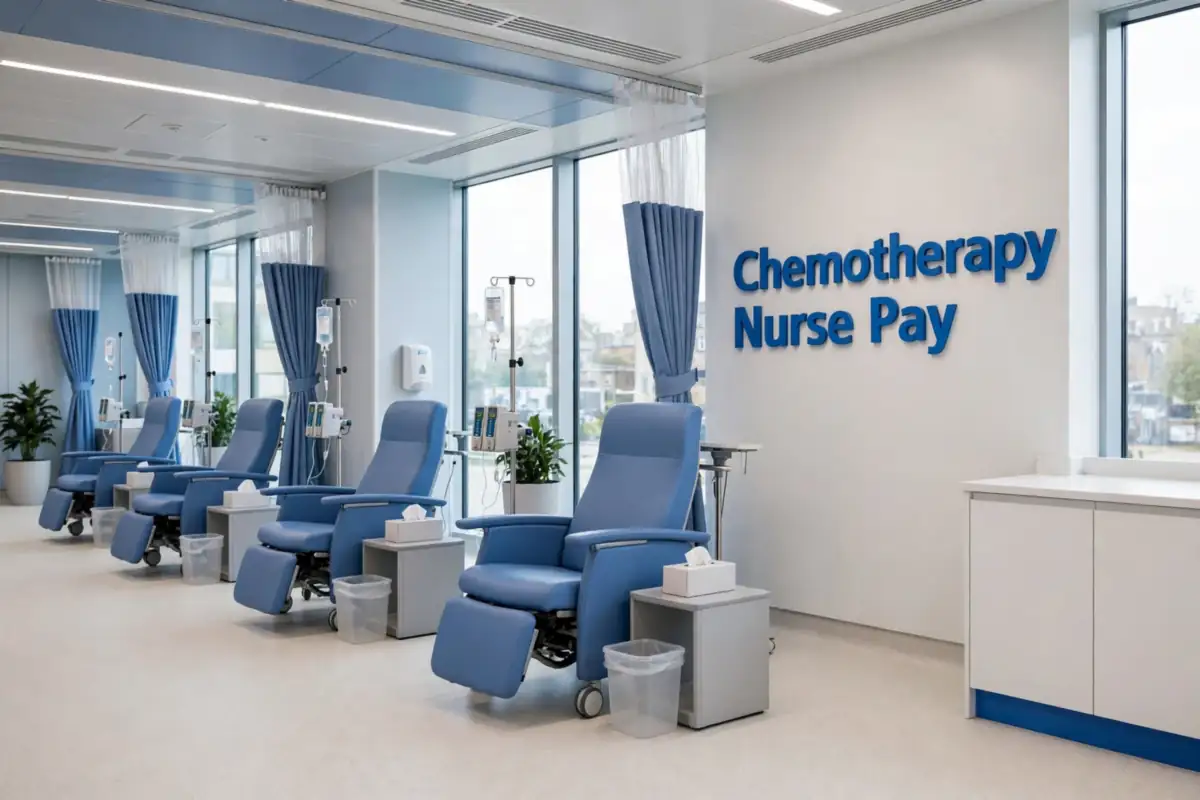
Chemotherapy Nurse Pay 2026/27
Last updated: 25 October 2026 · Figures verified against the NHS Employers 2026/27 pay circular.
What NHS chemotherapy nurses earn in 2026/27: the Band 5 and Band 6 salary ranges, hourly rates, SACT roles and training, on-call, unsocial hours, London weighting, pension, and the route into chemotherapy nursing.
Chemotherapy nurses give systemic anti-cancer therapy, known as SACT. That means the intravenous and oral cancer treatments given in chemotherapy day units, on oncology and haematology wards, and in some community settings. A patient on a course of treatment may come to the unit every week or every few weeks for months, so the nurse-patient relationship in this specialty runs far longer than on a general ward. The work blends precise technical practice with steady, long-term patient support: checking blood results before treatment, giving the drugs safely, watching for reactions during infusion, managing side effects between cycles, and helping patients and families understand what each cycle will feel like.
This page covers chemotherapy nurse pay for 2026/27 in England in full: the Band 5 and 6 salary figures, what SACT work actually involves, how training works in post, what unsocial hours, overtime and on-call add, London weighting, pension, and the route from ward nursing into the specialty. For the wider picture, see our guides to Band 5 and Band 6 pay, and our theatre nurse salary guide for the closest comparison on on-call working patterns.
Chemotherapy nurse salary 2026/27
The 2026/27 Agenda for Change rates for chemotherapy nurse posts in England, full-time at 37.5 hours a week, with 2025/26 for comparison:
| Band / point | 2026/27 annual | 2026/27 hourly | 2025/26 annual |
|---|---|---|---|
| Band 5 (entry) | £32,073 | £16.38 | £31,049 |
| Band 5 (intermediate) | £34,592 | £17.67 | n/a |
| Band 5 (top) | £39,043 | £19.95 | £37,796 |
| Band 6 (entry) | £39,959 | £20.41 | £38,682 |
| Band 6 (intermediate) | £42,170 | £21.54 | n/a |
| Band 6 (top) | £48,117 | £24.58 | £46,580 |
Source: NHS Employers Agenda for Change pay circular 2026/27 (England, full-time 37.5 hours a week). Hourly rates are annual salary divided by 52.2 weeks and 37.5 hours. The 2026/27 figures include the 3.3% consolidated award effective 1 April 2026.
The banding pattern is consistent: Band 5 for chemotherapy nurse posts (the usual entry point for nurses moving into the specialty), Band 6 for senior chemotherapy nurses and charge nurses who run a day-unit shift or a caseload area, and Band 7 for lead chemotherapy nurses and service managers (£49,387 to £56,515 in 2026/27). The step from the top of Band 5 (£39,043) to Band 6 entry (£39,959) is £916. Monthly equivalents run from £2,672.75 at Band 5 entry to £4,009.75 at the top of Band 6, before tax, National Insurance and pension deductions.
What a chemotherapy nurse actually does
Chemotherapy nursing is day-unit work with a caseload attached. A typical week for a Band 5 chemotherapy nurse might include:
- Pre-treatment assessment: checking blood results, symptoms and fitness for treatment before each cycle, and raising concerns with the oncology team when a patient is not ready for treatment that day.
- Administering SACT: giving intravenous chemotherapy and other systemic anti-cancer treatments, following the prescribed regimen, and monitoring patients closely during infusion for reactions.
- Oral SACT support: counselling patients on oral cancer medicines taken at home, including how to take them, what side effects to watch for, and when to call the unit.
- Side-effect management: assessing and treating nausea, fatigue, mouth problems, skin reactions and infection risk between cycles, and advising patients on self-care at home.
- Line and device care: caring for central lines and implanted ports used to deliver treatment, and working with the team that inserts and maintains them.
- Patient and family support: explaining each cycle in plain language, supporting patients through long courses of treatment, and signposting to dietetics, psychology, palliative care and benefits advice.
At Band 6, the balance shifts from doing to leading: the senior chemotherapy nurse runs the day-unit list, supervises the Band 5 team, handles the complex assessments and the difficult conversations, and takes responsibility for the safe running of the unit that day. The treatment work stays, because that is where the expertise is visible, but the week increasingly includes mentoring new SACT nurses, auditing practice, and working with pharmacy and oncology colleagues on service changes.
SACT training: how nurses qualify for chemotherapy work
No nurse walks into a chemotherapy unit and starts giving treatment unsupervised. SACT training is the in-post competency pathway that prepares a registered nurse to give systemic anti-cancer therapy safely. It combines taught theory on cancer treatments, their side effects and the emergencies that can arise, with supervised practice in a chemotherapy unit and formal competency sign-off before a nurse works unsupervised.
The practical shape of the pathway is set by the employing trust, so it varies from one cancer centre to another. Some trusts run a structured programme with study days and a portfolio; others build the training around supervised shifts with an experienced SACT nurse and staged sign-off for each treatment type. Either way, the principle is the same: theory first, supervised practice second, sign-off third, and ongoing assessment after that. Nurses already working on oncology or haematology wards often arrive with part of the knowledge in place, which is why ward experience in cancer care is the usual entry route.
Two points are worth checking before you apply. First, ask what the local SACT pathway looks like and how long supervised practice usually lasts in that trust, because the advert rarely spells it out. Second, ask whether the post includes study time for the theory element, or whether it is fitted around the day-unit list. The answers tell you a lot about how seriously a unit takes training, and they differ more between trusts than the salary figures do.
Day unit, ward and community: same band, different day
Chemotherapy nurse posts split across three settings, and the choice shapes the working week more than the pay does.
Day units are where most chemotherapy nursing happens. Patients arrive for a planned appointment, receive treatment over hours, and go home the same day. The day is planned around the treatment list: assessments in the morning, infusions through the day, and reviews before discharge home. Day-unit roles suit nurses who like predictable hours, technical precision and long-term patient relationships.
Inpatient wards cover patients admitted for treatment or for complications between cycles. The work is less predictable: admissions, symptom crises and treatment given to unwell patients who need closer monitoring. Ward roles suit nurses who like acute problem-solving and close medical team contact, and they are the usual stepping stone into day-unit posts.
Community SACT is the smallest part of the specialty but a growing one, with some treatments given in patients' homes or in community clinics. The work is autonomous: one nurse, one patient, and a long drive between visits in some services. The band and the basic pay are identical in all three settings; the difference is the work, the hours and the team around you.
Hours, unsocial hours, overtime and on-call
Chemotherapy nursing is mostly daytime and weekday: day-unit lists, clinics and ward rounds all happen in working hours. The exceptions are Saturday lists, which some services run to cut waiting times, and on-call cover for admitted patients in larger cancer centres. On-call arrangements are set locally within the Agenda for Change framework, so the payment depends on the trust and the rota: some cancer centres pay an on-call availability payment plus call-out rates for attending, while day-unit-only services run no on-call rota at all. The advert and the contract state the local arrangement, so ask about it before accepting a post. Our theatre nurse guide covers on-call working in depth for the specialty where on-call is most central.
Where hours fall in the unsocial windows, the Section 2 enhancements apply. At Band 5 the rates are time plus 41% for Saturdays and weekday nights and time plus 83% for Sundays and bank holidays. On 2026/27 basics that works out as: at Band 5, Saturday and weekday night rates of about £23.10 to £28.13 an hour across the band, and Sunday and bank holiday rates of about £29.98 to £36.51. At Band 6, where the rates are time plus 30% and time plus 60%, Saturday and weekday nights pay about £26.53 to £31.95 and Sundays and bank holidays about £32.66 to £39.33. For most chemotherapy nurses these enhancements are an occasional top-up rather than a routine part of earnings, which is why the basic salary figures above are the best guide to what the job pays. Our unsocial hours and overtime guide covers the Section 2 rules in full.
Under AfC Section 3, overtime for staff in Bands 1 to 7 is paid at time-and-a-half: about £24.57 an hour at Band 5 entry rising to £29.93 at the top of Band 5, and £30.62 to £36.87 across Band 6 in 2026/27. Overtime on bank holidays is double time, about £32.76 to £39.90 an hour at Band 5 and £40.82 to £49.16 at Band 6. Chemotherapy overtime clusters around Saturday lists and waiting-list work rather than night work. Staff at Band 8a and above have no contractual overtime pay and take time off in lieu instead.
London weighting (HCAS) for chemotherapy nurses
Chemotherapy nurses employed by London trusts receive the High Cost Area Supplement: 20% of basic pay in inner London (minimum £5,794, maximum £8,746), 15% in outer London (minimum £4,870, maximum £6,137) and 5% in the fringe zone (minimum £1,346, maximum £2,270). At chemotherapy nurse pay levels the minimums, not the maximums, are the binding constraint at the bottom of Band 5 in outer London.
Worked examples. A Band 5 chemotherapy nurse at entry in inner London: 20% of £32,073 is £6,414.60, which sits between the minimum and maximum, so it applies in full: £32,073 + £6,414.60 = £38,487.60 a year. At the top of Band 5, 20% of £39,043 is £7,808.60: £39,043 + £7,808.60 = £46,851.60 a year. In outer London at Band 5 entry, 15% of £32,073 is £4,810.95, below the £4,870 minimum, so the minimum applies: £32,073 + £4,870 = £36,943 a year. A Band 6 chemotherapy nurse at entry in inner London: 20% of £39,959 is £7,991.80: £39,959 + £7,991.80 = £47,950.80 a year. At the top of Band 6, 20% of £48,117 is £9,623.40, above the £8,746 maximum, so the cap applies: £56,863 a year. Our HCAS guide has the full zone map and explains how the supplement interacts with part-time pay.
Pension and benefits
Chemotherapy nurses are in the NHS Pension Scheme, the defined-benefit CARE (career average revalued earnings) scheme. Contribution tiers for 2026/27 are provisional:
- Band 5 entry (£32,073): 8.3% tier, about £221.84 a month (£2,662.06 a year).
- Band 5 intermediate (£34,592): 8.3% tier, about £239.26 a month (£2,871.14 a year).
- Band 5 top (£39,043): 9.8% tier, about £318.85 a month (£3,826.21 a year).
- Band 6 entry (£39,959): 9.8% tier, about £326.33 a month (£3,915.98 a year).
- Band 6 intermediate (£42,170): 9.8% tier, about £344.39 a month (£4,132.66 a year).
- Band 6 top (£48,117): 9.8% tier, about £392.96 a month (£4,715.47 a year).
The employer contributes 23.7% on top of your own contribution. Because the tiers are provisional for 2026/27, confirm the final rates on your payslip against our pension contributions guide. Standard AfC benefits apply: 27 days plus 8 bank holidays of annual leave for the first 5 years of service (29 plus 8 with 5 or more years, 33 plus 8 with 10 or more), full occupational sick pay and occupational maternity provisions. Nurses may also claim the HMRC flat-rate uniform allowance of £125 a year where they wash their own uniform, worth £25 a year in tax relief at the basic rate and £50 at the higher rate. Check each line of your first payslip, pension deductions, tax code and HCAS, with our payslip guide.
Chemotherapy nurse pay across the UK nations
The figures on this page are England rates. The devolved nations have their own pay deals:
- Scotland: 3.75% from 1 April 2026 under the two-year deal, with a 36-hour week from April 2026 (compared with 37.5 in England), which changes the hourly calculation for the same annual salary. The pay scales and steps differ slightly from England.
- Wales: 3.3% implemented from 1 April 2026, mirroring the English award, with the Welsh pay scales applying.
- Northern Ireland: the 3.3% award has been recommended but is not implemented. Do not budget on the 2026/27 figures for NI posts until implementation is confirmed.
How to become a chemotherapy nurse
The entry requirement is NMC registration as a registered nurse, plus clinical experience. Most Band 5 chemotherapy nurse adverts ask for post-registration experience, because credibility with patients and with the oncology team depends on having done the clinical job yourself. The usual routes in are medical wards, where cancer patients are a regular part of the caseload, and oncology or haematology wards, where the SACT work is already part of daily practice. Ward nurses who take on chemotherapy competencies in post often step into day-unit roles from there.
From Band 5, the specialty ladder runs to senior chemotherapy nurse at Band 6 (£39,959 to £48,117), then lead chemotherapy nurse and service manager roles at Band 7 (£49,387 to £56,515). It is worth comparing with the other specialist options at the same level: our clinical nurse specialist salary guide covers the Band 7 direct-care specialist alternative, and our theatre nurse guide covers the on-call-heavy alternative. All three pay the same band ranges, so the choice is about the work, not the money.
Pay progression
Chemotherapy nursing runs Band 5 to Band 7: chemotherapy nurse at Band 5 (often entered from ward, oncology or haematology nursing), senior or charge chemotherapy nurse at Band 6, and lead or service-manager roles into Band 7 and beyond. Compare the clinical nurse specialist and theatre nurse paths at the same bands. Read how Agenda for Change banding works to understand where each step sits.
Frequently asked questions
How much does an NHS chemotherapy nurse earn?
In 2026/27, NHS chemotherapy nurses in England earn £32,073 to £39,043 a year at Band 5 and £39,959 to £48,117 at Band 6, for a full-time 37.5-hour week under Agenda for Change. Senior and lead chemotherapy nurse posts sit at Band 7, at £49,387 to £56,515.
What band is a chemotherapy nurse in the NHS?
Chemotherapy nurse posts typically sit at Band 5 on qualification into the specialty, with senior chemotherapy nurses and charge nurses at Band 6 and lead chemotherapy nurses and service managers at Band 7. Ward nurses who give occasional chemotherapy as part of general ward work stay on their substantive band.
What does a chemotherapy nurse do?
Chemotherapy nurses give systemic anti-cancer therapy, known as SACT: intravenous and oral cancer treatments given in day units, on wards and sometimes in the community. The work covers pre-treatment assessment and blood-result checks, preparing and administering treatment, monitoring patients during and after infusion, managing side effects, and supporting patients and families through a course of treatment that may run for months.
What is SACT training for nurses?
SACT training is the in-post competency training that prepares a registered nurse to give systemic anti-cancer therapy safely. It combines taught theory on cancer treatments and their side effects with supervised practice in a chemotherapy unit and formal competency sign-off before a nurse works unsupervised. The exact programme and its length are set by the employing trust, so check the advert and ask at interview what the local SACT pathway looks like.
Do chemotherapy nurses work nights and weekends?
Most chemotherapy work is daytime and weekday, built around day-unit lists and clinic appointments. Some units run Saturday lists to cut waiting times, and larger cancer centres run on-call cover for admitted patients. Where hours fall in the unsocial windows, the Section 2 enhancements apply: at Band 5, time plus 41% for Saturdays and weekday nights and time plus 83% for Sundays and bank holidays; at Bands 6 and 7, time plus 30% and time plus 60%.
Do chemotherapy nurses get on-call pay?
On-call arrangements for chemotherapy nurses are set locally within the Agenda for Change framework, so the payment depends on the trust and the rota. Some cancer centres pay an on-call availability payment plus call-out rates for attending, while day-unit-only services run no on-call rota at all. The advert and the contract state the local arrangement, so ask about it before accepting a post.
Do chemotherapy nurses get London weighting?
Yes. Chemotherapy nurses in London trusts receive the High Cost Area Supplement: 20% of basic pay in inner London (minimum £5,794, maximum £8,746), 15% in outer London (minimum £4,870, maximum £6,137) and 5% in the fringe zone (minimum £1,346, maximum £2,270). A Band 5 chemotherapy nurse at entry in inner London earns £32,073 + £6,414.60 = £38,487.60 a year; at Band 6 entry the total is £39,959 + £7,991.80 = £47,950.80.
How do I become a chemotherapy nurse?
Chemotherapy nurse posts require NMC registration as a registered nurse, usually with clinical experience first. Most nurses enter through ward nursing, often on oncology, haematology or medical wards, building experience with cancer patients before applying for a Band 5 chemotherapy post. The trust then provides SACT competency training in post, with supervised practice and sign-off before unsupervised work.