
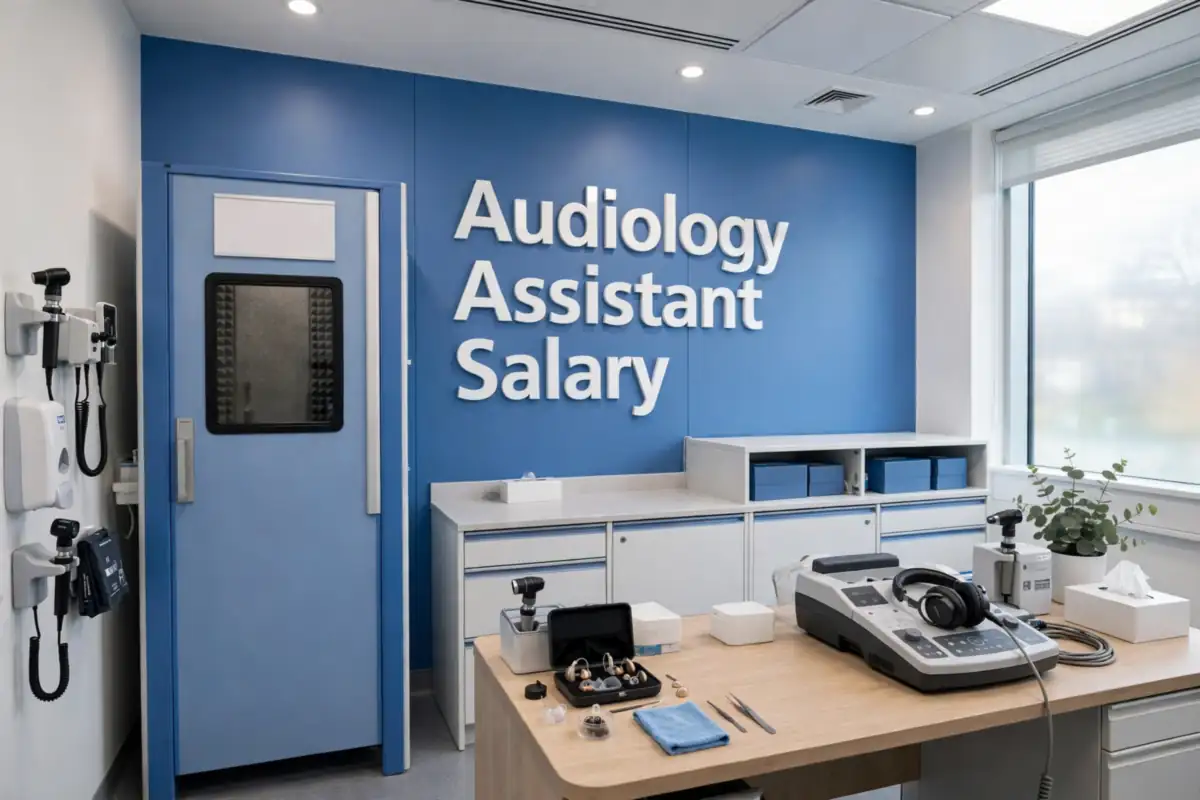
Audiology Assistant Salary 2026/27
Last updated: 9 November 2026 · Figures verified against the NHS Employers 2026/27 pay circular.
A hearing aid is a small, precise piece of technology, and for the person wearing it, it is the difference between following a conversation and sitting silently through it. When a hearing aid whistles, stops working, or no longer fits, the person who fixes it is usually an audiology assistant. The assistant runs the hearing aid repair clinic, takes the ear mould impression that a new aid is built around, checks the aid on a test box, retubes the earmould, changes the batteries, and talks the patient through looking after the aid at home. In children's services the assistant is the second tester in the hearing assessment, the person who keeps a small child engaged while the audiologist runs the test, and the person who helps run school hearing screening. None of that work needs a degree, and none of it is unskilled: it needs steady hands, patience with people who cannot hear you clearly, and an eye for the small faults that stop a hearing aid working. This page gives the full 2026/27 picture: the Band 3 scale, the hourly and monthly rates, take-home pay after pension, tax and National Insurance, unsocial-hours and overtime rules, London weighting, the pension, part-time pay, mileage, the training route into the post and the route onward to qualified audiologist, and how the figures differ in Scotland, Wales and Northern Ireland.
Audiology assistant pay 2026/27: the Band 3 scale
England awarded Agenda for Change staff 3.3% from 1 April 2026, and that award is already in these figures. An audiology assistant in England in 2026/27 earns £25,760 at Band 3 entry and £27,476 at the top of Band 3, for a full-time 37.5-hour week. Band 3 has two steps, entry and top, and the gap between them is £1,716 a year, or £143 a month gross. The banding is confirmed by the adverts themselves: a paediatric audiology assistant post was advertised at Band 3 in September 2026, an assistant audiologist post at Newcastle upon Tyne Hospitals was advertised at Band 3, a Band 3 assistant audiology practitioner post at London North West University Healthcare was advertised in November 2026, and an assistant audiologist post at Manchester University NHS Foundation Trust was advertised at Band 3 on a part-time 30-hour contract. The post is a support role, not a registered-clinician role, which is why it sits at Band 3 while qualified audiologists start at Band 5.
The 2026/27 England scale for a full-time 37.5-hour week. Hourly rates are annual pay divided by 52.2 weeks and then by 37.5 hours, rounded to the nearest penny, and enhancement rates on this page are calculated from that rounded hourly rate. Monthly pay is annual pay divided by 12. Weekly pay is annual pay divided by 52.2.
| Band and step | Annual | Monthly | Weekly | Hourly |
|---|---|---|---|---|
| Band 3 entry | £25,760 | £2,146.67 | £493.49 | £13.16 |
| Band 3 top | £27,476 | £2,289.67 | £526.36 | £14.04 |
For comparison, the 2025/26 ranges before the 3.3% award were £24,937 at entry and £26,598 at the top. The award lifted entry by £823 a year, or £68.58 a month, and the top by £878 a year, or £73.17 a month. No back pay was due in England because the increase was paid on time in April salaries. Progression from entry to the top of the band depends on a satisfactory appraisal and completion of statutory and mandatory training, and follows the trust's incremental progression policy. For the wider picture at the band, including the roles that share this scale, see the Band 3 salary guide, and for the qualified role above this one, the audiologist salary guide.
What audiology assistants actually do
The centre of the job is the hearing aid. A patient arrives at the repair clinic, often an older person who has worn hearing aids for years, and the aid is whistling, or the sound has gone faint, or the tube has hardened, or the earmould no longer sits comfortably. The assistant takes the aid, checks it, and works out what is wrong. That means fault finding on digital aids using the department's computer systems, fine adjustment of controls, retubing earmoulds, replacing batteries and tubing, and sending aids away for repair when the fault is beyond the clinic. The assistant runs hearing aid test box measurements, which check that an aid is producing the sound it should, and fits preselected analogue and digital hearing aids, including ward visits to patients who cannot come to the department. Some assistants run their own independent hearing aid repair clinics, seeing patients on their own and referring clinical decisions outside their scope to a senior practitioner. That autonomy is real, and it is also bounded: the assistant works within an agreed scope of practice, under the direct or indirect supervision of a qualified audiologist, and only after training and competency sign-off for each task.
Ear mould impressions are the other hands-on skill. The assistant examines the ear, takes an aural impression to British Society of Audiology standards, and the impression is what the new earmould is built from, so a poor impression means a poor fit and a patient who stops wearing the aid. The assistant also modifies earmoulds with training, using appropriate equipment, and orders and manages hearing aid stock, checking deliveries, auditing stock levels, and sending and receiving aids for repair and refurbishment. The stock work matters more than it sounds: a department that runs out of the right tubing or the right batteries leaves patients waiting, and the assistant is usually the person who notices first. Admin runs alongside the clinical work: scanning referrals and reports, checking the adult and paediatric email inboxes, responding to patient enquiries or forwarding them, booking clinics, and keeping calibration spreadsheets up to date, liaising with calibration and IT services where needed. A clear speaking voice is essential, because the patients have hearing loss, and the assistant is often the first line of contact for patients attending the department, including patients with dementia and patients distressed by tinnitus.
In children's services the work looks different again. The assistant supports two-tester clinics, acting as the second tester while the audiologist runs the assessment, keeping a small child engaged through visual reinforcement audiometry and play audiometry, and helping with tympanometry and otoscopy. The assistant prepares the consulting and testing rooms, chaperones ENT consultants, welcomes children and families, sorts post and hearing aid accessories, and helps run school hearing screening, carrying out screening tests in schools off site. Some children's assistants are healthcare assistants in audiology rather than assistant audiologists, and the title varies by trust, but the work is the same family of delegated clinical and operational duties, carried out under the direction of the clinical team. The radiography assistant salary guide, the medical laboratory assistant salary guide and the dietetic assistant salary guide cover the equivalent support roles in other departments, and the occupational therapy assistant salary guide covers the therapy support tier.
The work suits people who like fixing things and talking to people in equal measure. A morning in a repair clinic is a run of small problems solved one after another, each one with a person attached who wants to hear their grandchildren again. The assistant needs to be comfortable with patients who cannot hear clearly, which means speaking clearly, facing the patient, and checking understanding rather than assuming it. The assistant also needs to be organised, because the stock, the calibration records, the earmould orders and the clinic lists all run through the same person, and a department where the assistant is on leave feels it at once. It is not a stepping-stone post for everyone: many assistants stay in the role for years because they like the mix of hands-on repair work and patient contact, and the hours are mostly weekday clinics, which suits people who want a regular working week.
Band 3: what the band means, and the step from Band 2
Band 3 is the experienced support-worker band. It sits above Band 2, which is the entry support band, and below Band 4, where associate practitioner and senior support roles begin. The difference between Band 2 and Band 3 is delegated clinical work: a Band 3 audiology assistant carries out hearing aid repairs, takes ear mould impressions and supports hearing assessments on their own initiative within an agreed scope, while a Band 2 post is usually a healthcare assistant role with more basic duties. The pay difference is modest: Band 2 is a single spot salary of £25,272 in 2026/27, and Band 3 entry is £25,760, only £488 a year, or £40.67 a month, higher. The real difference is the work, not the money, and an assistant moving from Band 2 to Band 3 should expect the same again in responsibility: more autonomy, more direct patient contact, and more of the department's running to look after.
The step from the top of Band 3 to the entry of Band 4 is £916 a year, or £76.33 a month gross, since Band 4 entry is £28,392. That step is the one to aim for if the assistant wants to move up without leaving audiology: Band 4 posts in audiology are usually assistant practitioner or senior support roles, with more of the assessment work delegated. The bigger step is the one to qualified audiologist, which is a Band 5 post at £32,073 at entry, £4,597 a year above the top of Band 3, or £383.08 a month gross, and that step needs the degree, not just experience, which the training section below explains. For the full scales at each band, see the Band 2 salary guide, the Band 3 salary guide, the Band 4 salary guide and the Band 5 salary guide.
Job titles vary, and the variation confuses people. Assistant audiologist, assistant audiology practitioner, audiology technical officer, assistant technical officer and audiology assistant are all titles used for Band 3 posts in hearing services, and the same trust can use two of them at once. What matters is the band and the job description, not the title: if the post is Band 3, the pay is the Band 3 scale on this page, whatever the title says. Some adverts use the title healthcare assistant in audiology, which is the same band and the same family of work, usually in children's services. The audiologist salary guide covers the qualified role, and the Band 3 salary guide covers the band across all departments.
Take-home pay after pension, tax and National Insurance
Gross pay is not what arrives in the bank. The table below works out take-home pay for each Band 3 step in England, using the same method used across this site: the pension contribution comes off first, income tax is charged on what is left after the personal allowance, and National Insurance comes off gross pay. Student loan repayments are not in the table, and are dealt with separately below.
| Band and step | Gross per year | Pension | Income tax | National Insurance | Net per year | Net per month |
|---|---|---|---|---|---|---|
| Band 3 entry | £25,760 | 6.5% (£1,674.40) | £2,303.12 | £1,055.20 | £20,727.28 | £1,727.27 |
| Band 3 top | £27,476 | 6.5% (£1,785.94) | £2,624.01 | £1,192.48 | £21,873.57 | £1,822.80 |
Read the table across one row and the shape of an audiology assistant's payslip is clear. At Band 3 entry, on £25,760 a year, the pension takes £1,674.40, income tax takes £2,303.12 and National Insurance takes £1,055.20, leaving £20,727.28 a year, or £1,727.27 a month. At the top of Band 3, on £27,476, the pension takes £1,785.94, tax takes £2,624.01 and National Insurance takes £1,192.48, leaving £21,873.57 a year, or £1,822.80 a month. The step from entry to the top of the band is worth £95.53 a month in take-home, against a gross step of £143 a month, because the pension, tax and National Insurance all rise with the pay. The pension is the largest single deduction after tax, and it is also the deduction that buys the most, because it accrues pension at the 1/54th rate while cutting the tax bill.
Student loans are the good news on this page. Most staff who studied in England or Wales are on Plan 2, which takes 9% of earnings above £29,385 a year, and an audiology assistant earns £25,760 at entry and £27,476 at the top, so the Plan 2 deduction is £0 at both steps. That changes if the assistant earns more through overtime, unsocial-hours enhancements or a higher-banded post, because repayment is based on total earnings, not on basic pay alone, and a busy year with a lot of Saturday clinics can push total earnings over the threshold. Assistants who trained before the Plan 2 system, or who studied in Scotland, may be on a different plan with a different threshold. The student loan repayments on NHS pay guide works out the deduction for any salary and plan.
Unsocial hours and overtime
Most audiology work happens in weekday clinics, so unsocial-hours money is usually a smaller part of the payslip here than in ward roles, but the rates still apply whenever the hours are worked. Agenda for Change Section 2 pays Band 3 staff time plus 35% for Saturday and weekday night hours (8pm to 6am) and time plus 69% for Sunday and public-holiday hours. The table below applies those percentages to the rounded hourly rates from the scales above, and adds the overtime rates, which are time and a half for hours above 37.5 a week and double time on bank holidays. For the full unsocial-hours rules, including overtime and time off in lieu, see the unsocial hours and overtime guide.
| Band and step | Plain time | Saturday / night (+35%) | Sunday / bank holiday (+69%) | Overtime (x1.5) | Bank holiday overtime (x2) |
|---|---|---|---|---|---|
| Band 3 entry | £13.16 | £17.77 | £22.24 | £19.74 | £26.32 |
| Band 3 top | £14.04 | £18.95 | £23.73 | £21.06 | £28.08 |
Worked example: an audiology assistant at Band 3 entry works a Saturday hearing aid repair clinic of 7.5 hours. Plain time for the clinic would be £98.70 (7.5 hours at £13.16). At time plus 35%, the same clinic pays £133.28 (7.5 hours at £17.77). The enhancement alone is worth £34.58 for that one clinic. A second example, from the top of the band: an assistant at the top of Band 3 works a 7.5-hour Sunday shift. Plain time would be £105.30 (7.5 hours at £14.04). At time plus 69%, the shift pays £177.98 (7.5 hours at £23.73), an extra £72.68 for the day. Some departments run Saturday repair clinics regularly, and an assistant who covers them will see these rates on a predictable basis. An assistant whose post is mainly weekday clinics will see a payslip close to the basic monthly figure. That is why two assistants on the same band and step can take home different amounts, and why asking about the rota matters as much as asking about the band.
Overtime usually means staying past the end of a clinic, covering a colleague's sickness absence, or working an extra repair session when the caseload is under pressure. An assistant at the top of Band 3 who works 5 extra hours in a week at time and a half is paid 5 hours at £21.06, or £105.30, against £70.20 at plain time, an extra £35.10 for the week. Overtime is not a reliable part of the salary, and departments vary in how much they offer. An assistant budgeting on overtime every week is budgeting on something the department may withdraw, so the figures above are best read as the value of an occasional extra session, not as a second salary. Staff may elect time off in lieu instead of overtime pay, which suits assistants who would rather bank the hours after a run of Saturday clinics. Overtime and unsocial-hours enhancement cannot both be claimed for the same hours.
London weighting: the minimums do the work
High Cost Area Supplement is paid on top of basic pay for staff working in London and the fringe zone. In 2026/27, inner London pays 20% of basic pay (minimum £5,794, maximum £8,746), outer London pays 15% (minimum £4,870, maximum £6,137) and the fringe zone pays 5% (minimum £1,346, maximum £2,270). At Band 3 the minimums do all the work, because 20% of a Band 3 salary is less than the inner minimum and 15% is less than the outer minimum. An assistant at entry in inner London receives the £5,794 minimum, not 20% of the basic, for a total of £31,554, and at the top of Band 3 in inner London the total is £33,270. The same pattern holds in outer London, where the £4,870 minimum applies at both steps, and in the fringe zone, where the £1,346 minimum applies at entry and the 5% figure, £1,373.80, applies at the top. For the full HCAS rules, see the London weighting guide, and to work out the supplement for any salary, use the HCAS calculator.
| Band and step | Basic | Inner London total | Outer London total | Fringe total |
|---|---|---|---|---|
| Band 3 entry | £25,760 | £31,554.00 | £30,630.00 | £27,106.00 |
| Band 3 top | £27,476 | £33,270.00 | £32,346.00 | £28,849.80 |
The hourly view shows the same story. An assistant at entry in inner London earns £16.12 an hour, against £13.16 plain time, and at the top of Band 3 in inner London the hourly rate is £17. The minimums mean the supplement is flat across the band in inner and outer London, so the two steps differ only by the basic pay, not by the supplement. That is worth knowing when comparing a London post with a post outside London: the supplement adds £5,794 a year in inner London at both steps, which is a real sum, but it does not grow with the band, so the London advantage shrinks in percentage terms as the assistant moves up the ladder.
Pension: 6.5% at both steps
NHS pension contributions are the largest regular deduction after tax for most audiology assistants, and they are also the most valuable part of the package. Under the official 2026/27 England and Wales tiers, audiology assistants pay 6.5% of pensionable pay at both Band 3 steps, because both steps sit in the same tier. That is £139.53 a month at entry and £148.83 a month at the top. The employer contributes 23.7% on top of pensionable pay, which is £6,105.12 a year at entry and £6,511.81 a year at the top. The tiers are the official NHSBSA tiers, confirmed and in force from 1 April 2026. For the full tier table, see the pension contributions guide.
| Post | Tier | Employee per month | Employer per year |
|---|---|---|---|
| Band 3 entry (£25,760) | 6.5% | £139.53 | £6,105.12 |
| Band 3 top (£27,476) | 6.5% | £148.83 | £6,511.81 |
Each year of service accrues pension at 1/54th of pensionable earnings in the 2015 CARE scheme, so a year at Band 3 entry accrues £477.04 of annual pension and a year at the top accrues £508.81. The built-up pension is revalued each April. The contribution also cuts the tax bill, because it comes off before tax: at Band 3 entry the pension contribution saves £334.88 of income tax a year, which is the 20% rate applied to the £1,674.40 contribution. That tax saving is part of the value of the scheme, and it is the reason the take-home figures on this page are worked out with the pension taken off first. Pensionable pay is basic pay plus any pensionable allowances, and for most audiology assistants that means basic pay alone, since unsocial-hours enhancements and overtime are not pensionable. The tier is set by your actual pensionable pay, so a part-time assistant is tiered on the part-time earnings they actually receive, not on the full-time rate for the post.
Part-time work, annual leave, mileage and uniform relief
Part-time pay in Agenda for Change is pro rata to the whole-time equivalent fraction. An audiology assistant at Band 3 entry on a 0.6 whole-time equivalent contract earns £15,456 a year, and an assistant at the top of Band 3 on a 0.8 contract earns £21,980.80 a year. Unsocial-hours percentages and HCAS apply to the pro rata basic in the same way as to a full-time basic, and pension contributions are calculated on the actual pensionable pay, not the whole-time equivalent figure. A worked example shows the shape of it: a Band 3 assistant at entry on 0.6 whole-time equivalent earns £15,456 a year, the pension tier is 6.5%, set by the £15,456 actually earned, and it takes £1,004.64 a year, income tax is £376.27 a year and National Insurance is £230.88, leaving take-home of £13,844.21 a year, or £1,153.68 a month. Part-time posts are common in audiology, and one advert checked for this page was a part-time 30-hour assistant audiologist post, which is 0.8 whole-time equivalent. For the full pro-rata rules, see the part-time pay guide.
Annual leave follows the Agenda for Change tiers: 27 days on joining, 29 days after five years of service and 33 days after ten years, plus eight bank holidays, with part-time leave calculated pro rata in hours. An assistant who works Saturdays will take some of those bank holidays as working days and receive the unsocial-hours enhancement instead, which is the standard trade in seven-day services. For the full leave rules, see the annual leave guide.
Mileage is the other regular money for audiology assistants who travel between sites. Under Agenda for Change Section 17, a car user is paid 59p a mile for the first 4,500 miles in a year and 36p a mile after that. An assistant driving 5,000 miles in a year receives £2,835, and an assistant driving 4,000 miles receives £2,360. Mileage is an expense reimbursement, not pay, and it is kept separate from salary in every example on this page. Assistants who visit schools for hearing screening, or who work across several hospital sites, will claim far more mileage than assistants based in a single clinic. For the full rates and more worked examples, see the mileage rates guide. Assistants who wear a uniform can also claim flat-rate tax relief for laundry: audiology assistants are not named in the HMRC list, so the default £60 a year applies, worth £12 a year at the 20% tax rate and £24 a year at the 40% rate. It is a small sum, but it is claimed through the tax code and costs nothing to ask for. For the full list, see the uniform tax rebate guide.
Adults or children: two versions of the same job
The same band and step can mean two quite different weeks, depending on whether the post is in an adult service or a children's service. The adult-service assistant works with older patients, runs hearing aid repair clinics, takes ear mould impressions, fits preselected aids and deals with the stock and admin of a busy department. The day is structured by repair clinics and fitting appointments, and the assistant spends a good part of the week talking to patients who have worn hearing aids for years and know exactly what is wrong with them. The children's-service assistant works with families, schools and nurseries, supports two-tester clinics, helps run school hearing screening, and takes the developmental history from parents. The day is structured by clinic lists, school visits and multidisciplinary team meetings, and the assistant spends more of the week keeping small children engaged through a test. Both earn the same basic for the same band and step, and both earn the same HCAS for the same zone.
Pay differs between the versions mainly through unsocial hours and mileage, not through basic pay. The children's assistant who visits schools across a county earns more mileage, and may earn less unsocial-hours money if the service is mainly weekdays. The adult-service assistant in a department that runs Saturday repair clinics earns unsocial-hours money for those sessions. An assistant choosing between the two should weigh the working pattern honestly: children's work offers variety, school visits and close work with families, adult work offers depth, regular patients and the satisfaction of fixing a hearing aid on the spot. The children's nurse salary guide covers the paediatric side of the work, and the audiologist salary guide covers the qualified role in both services.
How to become an audiology assistant, and the route to audiologist
There is no degree requirement for an audiology assistant post. Some adverts ask for GCSE English and Maths at grade C or above, plus experience of working with people, and the training is done on the job, with competency sign-off for each task: hearing aid repairs, ear mould impressions, hearing aid test box measurements and the clinical admin that keeps a department running. A clear speaking voice is essential, because the patients have hearing loss, and experience of working with people with a disability helps, though it is not always asked for. The post is a genuine entry route into healthcare science: it needs no university qualification, and it puts the assistant inside a clinical department from the first day, learning the equipment, the patients and the team.
From there, the route to qualified audiologist is the Practitioner Training Programme, a healthcare science degree that leads to registration and a Band 5 audiologist post. Some audiology assistants take that route after a few years in the department, and the experience counts: an assistant who has spent years in repair clinics and two-tester clinics knows the equipment and the patients before the degree starts, which is a real advantage over a school leaver. Trainee audiologists employed by the NHS are paid under Annex 21, which pays a percentage of the band maximum depending on time to completion, from 60% to 75%. For the full trainee rules, see the Annex 21 trainee pay guide. The audiologist salary guide covers the Band 5 to Band 7 ladder that follows, and the clinical scientist salary guide covers the wider healthcare science family. A second route exists for assistants who prefer to stay in support work: Band 4 assistant practitioner posts, with more of the assessment work delegated, and senior support roles in larger departments.
Audiology is a small, well-connected field: most departments know each other, the British Society of Audiology sets the standards for the work, and the posts are few enough that a move usually means moving department or moving trust. That smallness is both the opportunity and the risk: a good audiology assistant is hard to replace, and a department that loses one feels it at once, but there are fewer posts to move between than in a large specialty such as ward nursing. The field is steady rather than fast growing, and adverts for assistant posts appear regularly across England, which is why this page exists: the role has become a career in its own right rather than a side duty inside another post.
Scotland, Wales and Northern Ireland
Scotland awarded 3.75% from 1 April 2026 under its two-year deal, and moved to a 36-hour week from April 2026. The Scotland scale is its own, published in the circular PCS(AFC)2026/1. For the band on this page, Scotland Band 3 pays £29,103 at entry and £31,409 at the top, or £15.50 and £16.73 an hour on the 36-hour week, against £13.16 and £14.04 an hour in England. That is £3,343 a year more at entry and £3,933 a year more at the top, and the shorter week is worth real money in hourly terms. Scotland Band 3 monthly pay is £2,425.25 at entry and £2,617.42 at the top. The shorter week also changes the overtime threshold, since overtime in Scotland starts above 36 hours rather than 37.5. Scotland also has its own nine-tier pension structure, and Band 3 falls in the 7.0% tier, which is £169.77 a month at entry and £183.22 a month at the top, with an employer contribution of 22.5%, which is £6,548.18 a year at entry and £7,067.03 a year at the top.
Wales awarded 3.3%, implemented 1 April 2026 and paid on time. The Real Living Wage floor applies to the lowest bands in Wales, at £13.45 an hour, or £26,300 a year for a full-time post. Wales Band 3 salary steps are not quoted on this page, because the full Wales scale for Band 3 is not in the verified data file, and this page quotes no figure it cannot verify.
Northern Ireland is different: the 3.3% award was recommended but had not been implemented at the time the data file was last checked, so Northern Ireland audiology assistant pay should not be budgeted on the England figures. Staff there remain on the 2025/26 scale, which is Band 3 £24,937 at entry and £26,598 at the top, or £12.74 and £13.59 an hour, and £2,078.08 and £2,216.50 a month, in payment now. The Scotland pay guide, the Wales pay guide and the Northern Ireland pay guide carry the nation positions in full.
NHS or private hearing care: the honest comparison
There is no single answer, because the two settings pay in different ways. An employed NHS post pays a banded salary with the pension, sick pay, annual leave and unsocial-hours structure described on this page, and the salary is the same regardless of how many hearing aids are repaired in a clinic. Private hearing care is also usually employed work, and this page quotes no private-sector rates, because terms vary by provider and by region and no verified national figure exists for them. Some private providers deliver NHS-commissioned audiology services on Agenda for Change terms, including the pension, so a post with such a provider can look very much like an NHS post on the payslip, and the advert will say so when that is the case. An assistant who values a predictable monthly salary, an NHS pension and paid leave will usually prefer the employed NHS route. An assistant who wants to work across several providers, or to pick up additional sessions, may combine an NHS post with private-sector work, accepting that the second job has to be declared and checked against working-time rules, because the conflict checks apply even when the second job is in a different setting. The second job rules guide covers the declarations and the tax code side of that choice.
The more practical comparison for most audiology assistants is not NHS against private sector, but Band 3 against Band 5. The net pay step between the top of Band 3 and the entry of Band 5 is large: £4,597 a year gross, or £383.08 a month, and the real gain is the ceiling: a qualified audiologist tops out at Band 7, £56,515 a year, against £27,476 at the top of Band 3. An assistant who wants the higher ceiling should look at the Practitioner Training Programme degree, because that is the duty that moves a post from Band 3 to Band 5, and the person specifications for trainee audiologist posts say so.
Pay progression
From Band 3 entry (£25,760), the ladder runs through Band 3 top (£27,476) to Band 4 entry (£28,392) for senior support posts, and to Band 5 entry (£32,073) for qualified audiologists who complete the Practitioner Training Programme degree. Beyond Band 5, the routes are Band 6 senior audiologist and Band 7 specialist and lead posts, each of which is a separate post with its own banding rather than an automatic step. The audiologist salary guide covers the qualified ladder, the Band 3 salary guide covers the band across all departments, and the Annex 21 trainee pay guide covers the trainee route. To work out your own hourly rate from any salary, use the hourly rate calculator.
Frequently asked questions
What band is an audiology assistant?
Audiology assistants are Band 3. In England in 2026/27, Band 3 pays £25,760 at entry and £27,476 at the top, for a full-time 37.5-hour week. That is £13.16 an hour at entry and £14.04 an hour at the top. The banding is confirmed by the adverts themselves: a paediatric audiology assistant post was advertised at Band 3 in September 2026, an assistant audiologist post at Newcastle upon Tyne Hospitals was advertised at Band 3, and a Band 3 assistant audiology practitioner post at London North West University Healthcare was advertised in November 2026. Audiology assistants support qualified audiologists rather than running their own clinics, which is why the post sits at Band 3 while qualified audiologists start at Band 5.
How much does an audiology assistant earn a month?
In England in 2026/27, an audiology assistant earns £2,146.67 a month at Band 3 entry and £2,289.67 a month at the top of Band 3, before tax, National Insurance and pension deductions. Those are gross figures for a full-time 37.5-hour week. After pension, tax and National Insurance, take-home pay is £1,727.27 a month at entry and £1,822.80 a month at the top. Unsocial-hours enhancements, overtime and London weighting can lift both figures, and part-time pay is pro rata to the contracted hours.
Do audiology assistants get unsocial-hours pay?
Yes, when the hours are worked. Agenda for Change Section 2 pays Band 3 staff time plus 35% for Saturday and weekday night hours (8pm to 6am) and time plus 69% for Sunday and public-holiday hours. An audiology assistant at Band 3 entry earns £17.77 an hour on a Saturday or at night and £22.24 on a Sunday or bank holiday, against £13.16 plain time. At the top of Band 3, £14.04 an hour becomes £18.95 and £23.73. Most audiology work happens in weekday clinics, so unsocial-hours money is usually a smaller part of the payslip than in ward roles, but Saturday hearing aid repair clinics do exist, and assistants who cover them earn these rates for the hours they work.
Do audiology assistants get London weighting?
Yes, in London. High Cost Area Supplement in 2026/27 is 20% of basic pay in inner London (minimum £5,794, maximum £8,746), 15% in outer London (minimum £4,870, maximum £6,137) and 5% in the fringe zone (minimum £1,346, maximum £2,270). At Band 3 the minimums do all the work: an audiology assistant at entry in inner London receives the £5,794 minimum, not 20% of the basic, for a total of £31,554, and at the top of Band 3 in inner London the total is £33,270. In outer London the totals are £30,630 at entry and £32,346 at the top, and in the fringe zone they are £27,106 at entry and £28,849.80 at the top.
What pension contribution does an audiology assistant pay?
Under the official 2026/27 England and Wales tiers, audiology assistants pay 6.5% of pensionable pay at both Band 3 steps, because both steps sit in the same tier. That is £139.53 a month at entry and £148.83 a month at the top. The employer contributes 23.7% on top, which is £6,105.12 a year at entry and £6,511.81 a year at the top. The tiers are the official NHSBSA tiers, confirmed and in force from 1 April 2026. Each year of service accrues pension at 1/54th of pensionable earnings in the 2015 CARE scheme, so a year at Band 3 entry accrues £477.04 of annual pension and a year at the top accrues £508.81.
Can an audiology assistant work part-time?
Yes. Part-time pay in Agenda for Change is pro rata to the whole-time equivalent fraction. An audiology assistant at Band 3 entry on a 0.6 whole-time equivalent contract earns £15,456 a year, and an assistant at the top of Band 3 on a 0.8 contract earns £21,980.80 a year. Unsocial-hours percentages and High Cost Area Supplement apply to the pro rata basic in the same way as to a full-time basic. A worked example: a Band 3 assistant at entry on 0.6 whole-time equivalent earns £15,456 a year, the pension takes £1,004.64, income tax takes £376.27 and National Insurance takes £230.88, leaving take-home of £13,844.21 a year, or £1,153.68 a month. The pension tier is set by the part-time earnings of £15,456, not by the whole-time equivalent salary, and that is the 6.5% tier.
Do audiology assistants pay student loan?
Most do not, because both Band 3 steps sit below the Plan 2 repayment threshold. Plan 2 takes 9% of earnings above £29,385 a year, and an audiology assistant earns £25,760 at entry and £27,476 at the top, so the Plan 2 deduction is £0 at both steps. That changes if the assistant earns more through overtime, unsocial-hours enhancements or a higher-banded post: repayment is based on total earnings, not on basic pay alone. Assistants who trained before the Plan 2 system, or who studied in Scotland, may be on a different plan with a different threshold, and the student loan repayments guide on this site works out the deduction for any salary and plan.
How do you become an audiology assistant, and can you progress to audiologist?
There is no degree requirement for an audiology assistant post. Some adverts ask for GCSE English and Maths at grade C or above, plus experience of working with people, and the training is done on the job, with competency sign-off for each task: hearing aid repairs, ear mould impressions, hearing aid test box measurements and the clinical admin that keeps a department running. From there, the route to qualified audiologist is the Practitioner Training Programme, a healthcare science degree that leads to registration and a Band 5 audiologist post, and some audiology assistants take that route after a few years in the department. Trainee audiologists employed by the NHS are paid under Annex 21, which pays a percentage of the band maximum depending on time to completion. The audiologist salary guide on this site covers the Band 5 to Band 7 ladder that follows.
Sources and independence
Source: NHS Employers, Unsocial hours payments (Agenda for Change Section 2 rates) and the Agenda for Change pay circular 2026/27 (England pay scales, High Cost Area Supplement, pension tiers and mileage rates).
Source: NHSBSA, official 2026/27 pension contribution tiers for England and Wales (in force from 1 April 2026); NHS Scotland circular PCS(AFC)2026/1 (Scotland 2026/27 scale and 36-hour week); NHS Scotland pension tiers 2026/27 (SPPA, Table 2).
Source: British Society of Audiology, thebsa.org.uk (the professional body for audiology in the UK, which sets the standards for aural impression taking and hearing assessment).
Source: Job descriptions and adverts checked 9 November 2026: Paediatric Audiology Assistant, Band 3 (Trac job description, September 2026); Assistant Audiologist, Band 3, Newcastle upon Tyne Hospitals NHS Foundation Trust (Job Evaluation ENT/PTA/ENT/TRT/052); Band 3 Assistant Audiology Practitioner, London North West University Healthcare NHS Trust (published 4 November 2026); Assistant Audiologist, Band 3, part-time 30 hours a week, Manchester University NHS Foundation Trust (Trac); Band 3 Health Care Assistant (Paediatric Audiology), Barnsley.
NHS Bands Pay is an independent guide and is not affiliated with the NHS, NHS Employers, the British Society of Audiology or any NHS trust. Figures were verified against the official sources above on 9 November 2026 and can change, always confirm with the relevant official body before making financial decisions.